



购物车
 您的购物车当前为空


 还可以
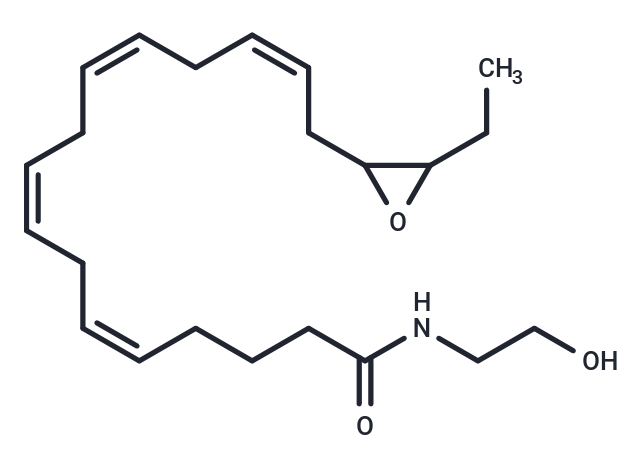
还可以(±)17(18)-EpETE-Ethanolamide, an ω-3 endocannabinoid epoxide, originates from eicosapentaenoic ethanolamide (EPEA) through cytochrome P450 (CYP) epoxygenases action and is decomposed by soluble epoxide hydrolase (sEH) and fatty acid amide hydrolase (FA, AH). Its endogenous synthesis occurs in LPS-stimulated and EPEA-supplemented BV-2 microglia cells, a process inhibited by the CYP inhibitor ketoconazole. This compound mitigates IL-6 and nitrite levels while enhancing IL-10 production following LPS exposure in BV-2 microglia. At a dose of 50 µM, it prevents platelet aggregation caused by arachidonic acid but not that triggered by ADP, collagen, or ristocetin. Additionally, it facilitates the dilation of constricted bovine coronary arteries (ED50= 1.1 µM) and blocks VEGF-driven tubulogenesis in human microvascular endothelial cells (HMVECs).
还可以别名 17,18-epoxy-Eicosatetraenoic Acid Ethanolamide, 17,18-EEQ-EA, (±)17,18-EEQ-Ethanolamide, (±)17(18)-EpETE-EA
(±)17(18)-EpETE-Ethanolamide, an ω-3 endocannabinoid epoxide, originates from eicosapentaenoic ethanolamide (EPEA) through cytochrome P450 (CYP) epoxygenases action and is decomposed by soluble epoxide hydrolase (sEH) and fatty acid amide hydrolase (FA, AH). Its endogenous synthesis occurs in LPS-stimulated and EPEA-supplemented BV-2 microglia cells, a process inhibited by the CYP inhibitor ketoconazole. This compound mitigates IL-6 and nitrite levels while enhancing IL-10 production following LPS exposure in BV-2 microglia. At a dose of 50 µM, it prevents platelet aggregation caused by arachidonic acid but not that triggered by ADP, collagen, or ristocetin. Additionally, it facilitates the dilation of constricted bovine coronary arteries (ED50= 1.1 µM) and blocks VEGF-driven tubulogenesis in human microvascular endothelial cells (HMVECs).
| 规格 | 价格 | 库存 | 数量 |
|---|---|---|---|
| 10 mg | 待询 | 8-10周 | |
| 50 mg | 待询 | 8-10周 |
TargetMol的所有产品仅用作科学研究或药证申报,不能被用于人体,我们不向个人提供产品和服务。请您遵守承诺用途,不得违反法律法规规定用于任何其他用途。
| 产品描述 | (±)17(18)-EpETE-Ethanolamide, an ω-3 endocannabinoid epoxide, originates from eicosapentaenoic ethanolamide (EPEA) through cytochrome P450 (CYP) epoxygenases action and is decomposed by soluble epoxide hydrolase (sEH) and fatty acid amide hydrolase (FA, AH). Its endogenous synthesis occurs in LPS-stimulated and EPEA-supplemented BV-2 microglia cells, a process inhibited by the CYP inhibitor ketoconazole. This compound mitigates IL-6 and nitrite levels while enhancing IL-10 production following LPS exposure in BV-2 microglia. At a dose of 50 µM, it prevents platelet aggregation caused by arachidonic acid but not that triggered by ADP, collagen, or ristocetin. Additionally, it facilitates the dilation of constricted bovine coronary arteries (ED50= 1.1 µM) and blocks VEGF-driven tubulogenesis in human microvascular endothelial cells (HMVECs). |
| 别名 | 17,18-epoxy-Eicosatetraenoic Acid Ethanolamide, 17,18-EEQ-EA, (±)17,18-EEQ-Ethanolamide, (±)17(18)-EpETE-EA |
| 分子量 | 361.52 |
| 分子式 | C22H35NO3 |
| CAS No. | 2123491-23-4 |
| Smiles | C(/C=C\C/C=C\C/C=C\C/C=C\CCCC(NCCO)=O)C1C(CC)O1 |
| 存储 | Powder: -20°C for 3 years | In solvent: -80°C for 1 year Shipping with blue ice/Shipping at ambient temperature. 实际储存温度请以COA为准 |
对于不同动物的给药剂量换算,您也可以参考 更多

 嗨!有任何问题?点我咨询

版权所有©2015-2026 TargetMol Chemicals Inc.保留所有权利.
沪ICP备20019793号-4 | 沪公网安备 31010602006700号 | 沪(静)应急管危经许[2024]203441