



购物车
 您的购物车当前为空

 很棒
很棒Plays a role in the degradation of extracellular matrix proteins including fibrillar collagen, fibronectin, TNC and ACAN. Cleaves triple helical collagens, including type I, type II and type III collagen, but has the highest activity with soluble type II collagen. Can also degrade collagen type IV, type XIV and type X. May also function by activating or degrading key regulatory proteins, such as TGFB1 and CCN2. Plays a role in wound healing, tissue remodeling, cartilage degradation, bone development, bone mineralization and ossification. Required for normal embryonic bone development and ossification. Plays a role in the healing of bone fractures via endochondral ossification. Plays a role in wound healing, probably by a mechanism that involves proteolytic activation of TGFB1 and degradation of CCN2. Plays a role in keratinocyte migration during wound healing. May play a role in cell migration and in tumor cell invasion.
很棒别名 Mmp13, Matrix metalloproteinase-13 (MMP-13), Collagenase 3
Plays a role in the degradation of extracellular matrix proteins including fibrillar collagen, fibronectin, TNC and ACAN. Cleaves triple helical collagens, including type I, type II and type III collagen, but has the highest activity with soluble type II collagen. Can also degrade collagen type IV, type XIV and type X. May also function by activating or degrading key regulatory proteins, such as TGFB1 and CCN2. Plays a role in wound healing, tissue remodeling, cartilage degradation, bone development, bone mineralization and ossification. Required for normal embryonic bone development and ossification. Plays a role in the healing of bone fractures via endochondral ossification. Plays a role in wound healing, probably by a mechanism that involves proteolytic activation of TGFB1 and degradation of CCN2. Plays a role in keratinocyte migration during wound healing. May play a role in cell migration and in tumor cell invasion.

| 规格 | 价格 | 库存 | 数量 |
|---|---|---|---|
| 5 μg | ¥ 656 | 3日内发货 | |
| 10 μg | ¥ 1,070 | 现货 | |
| 20 μg | ¥ 1,800 | 现货 | |
| 50 μg | ¥ 2,730 | 20日内发货 | |
| 100 μg | ¥ 3,760 | 20日内发货 | |
| 200 μg | ¥ 5,780 | 20日内发货 | |
| 500 μg | ¥ 9,870 | 20日内发货 | |
| 1 mg | ¥ 16,000 | 20日内发货 |
TargetMol的所有产品仅用作科学研究或药证申报,不能被用于人体,我们不向个人提供产品和服务。请您遵守承诺用途,不得违反法律法规规定用于任何其他用途。
| 产品描述 | Plays a role in the degradation of extracellular matrix proteins including fibrillar collagen, fibronectin, TNC and ACAN. Cleaves triple helical collagens, including type I, type II and type III collagen, but has the highest activity with soluble type II collagen. Can also degrade collagen type IV, type XIV and type X. May also function by activating or degrading key regulatory proteins, such as TGFB1 and CCN2. Plays a role in wound healing, tissue remodeling, cartilage degradation, bone development, bone mineralization and ossification. Required for normal embryonic bone development and ossification. Plays a role in the healing of bone fractures via endochondral ossification. Plays a role in wound healing, probably by a mechanism that involves proteolytic activation of TGFB1 and degradation of CCN2. Plays a role in keratinocyte migration during wound healing. May play a role in cell migration and in tumor cell invasion. |
| 生物活性 | Activity has not been tested. It is theoretically active, but we cannot guarantee it. If you require protein activity, we recommend choosing the eukaryotic expression version first. |
| 研究背景 | Plays a role in the degradation of extracellular matrix proteins including fibrillar collagen, fibronectin, TNC and ACAN. Cleaves triple helical collagens, including type I, type II and type III collagen, but has the highest activity with soluble type II collagen. Can also degrade collagen type IV, type XIV and type X. May also function by activating or degrading key regulatory proteins, such as TGFB1 and CCN2. Plays a role in wound healing, tissue remodeling, cartilage degradation, bone development, bone mineralization and ossification. Required for normal embryonic bone development and ossification. Plays a role in the healing of bone fractures via endochondral ossification. Plays a role in wound healing, probably by a mechanism that involves proteolytic activation of TGFB1 and degradation of CCN2. Plays a role in keratinocyte migration during wound healing. May play a role in cell migration and in tumor cell invasion. |
| 种属 | Mouse |
| 表达系统 | E. coli |
| 标签 | N-6xHis |
| 蛋白编号 | P33435 |
| 氨基酸序列 | YNVFPRTLKWSQTNLTYRIVNYTPDMSHSEVEKAFRKAFKVWSDVTPLNFTRIYDGTADIMISFGTKEHGDFYPFDGPSGLLAHAFPPGPNYGGDAHFDDDETWTSSSKGYNLFIVAAHELGHSLGLDHSKDPGALMFPIYTYTGKSHFMLPDDDVQGIQFLYGPGDEDPNPKHPKTPEKCDPALSLDAITSLRGETMIFKDRFFWRLHPQQVEAELFLTKSFWPELPNHVDAAYEHPSRDLMFIFRGRKFWALNGYDILEGYPRKISDLGFPKEVKRLSAAVHFENTGKTLFFSENHVWSYDDVNQTMDKDYPRLIEEEFPGIGNKVDAVYEKNGYIYFFNGPIQFEYSIWSNRIVRVMPTNSILWC |
| 蛋白构建 | 105-472 aa |
| 蛋白纯度 | > 90% as determined by SDS-PAGE. 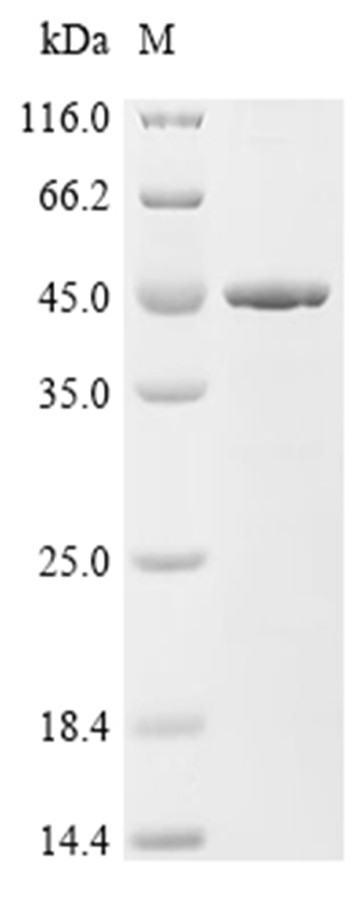 |
| 缓冲液 | Tris-based buffer, 50% glycerol |
| 复溶方法 | A Certificate of Analysis (CoA) containing reconstitution instructions is included with the products. Please refer to the CoA for detailed information. |
| 别名 | Mmp13, Matrix metalloproteinase-13 (MMP-13), Collagenase 3 |
| 内毒素 | < 1.0 EU/μg of the protein as determined by the LAL method. |
| 分子量 | 46.5 kDa (predicted) |
| 运输方式 | In general, lyophilized powders are shipped with blue ice, while solutions are shipped with dry ice. |
| 存储 | Lyophilized powders can be stably stored for over 12 months, while liquid products can be stored for 6-12 months at -80°C. For reconstituted protein solutions, the solution can be stored at -20°C to -80°C for at least 3 months. Please avoid multiple freeze-thaw cycles and store products in aliquots. 实际储存温度请以COA为准 |
对于不同动物的给药剂量换算,您也可以参考 更多

 嗨!有任何问题?点我咨询

版权所有©2015-2026 TargetMol Chemicals Inc.保留所有权利.
沪ICP备20019793号-4 | 沪公网安备 31010602006700号 | 沪(静)应急管危经许[2024]203441