



购物车
 您的购物车当前为空

 很棒
很棒L1CAM Protein, Human, Recombinant (His) is expressed in HEK293 mammalian cells with His tag. The predicted molecular weight is 125 kDa and the accession number is P32004-1.
很棒纯度: 98.5%
别名 SPG1, S10, NCAM-L1, N-CAM-L1, N-CAML1, MIC5, MASA, L1 cell adhesion molecule, HSAS1, HSAS, CD171, CAML1
L1CAM Protein, Human, Recombinant (His) is expressed in HEK293 mammalian cells with His tag. The predicted molecular weight is 125 kDa and the accession number is P32004-1.
| 规格 | 价格 | 库存 | 数量 |
|---|---|---|---|
| 5 μg | ¥ 429 | 现货 | |
| 10 μg | ¥ 697 | 现货 | |
| 20 μg | ¥ 1,150 | 现货 | |
| 50 μg | ¥ 2,260 | 现货 | |
| 100 μg | ¥ 3,820 | 5日内发货 | |
| 200 μg | ¥ 6,750 | 5日内发货 | |
| 500 μg | ¥ 14,200 | 5日内发货 |
TargetMol的所有产品仅用作科学研究或药证申报,不能被用于人体,我们不向个人提供产品和服务。请您遵守承诺用途,不得违反法律法规规定用于任何其他用途。
| 产品描述 | L1CAM Protein, Human, Recombinant (His) is expressed in HEK293 mammalian cells with His tag. The predicted molecular weight is 125 kDa and the accession number is P32004-1. |
| 生物活性 | Activity testing is in progress. It is theoretically active, but we cannot guarantee it. If you require protein activity, we recommend choosing the eukaryotic expression version first. |
| 研究背景 | L1 cell adhesion molecule (L1CAM), also designated as CD171, is a cell adhesion receptor of the immunoglobulin superfamily, known for its roles in nerve cell function. While originally believed to be present only in brain cells, in recent years L1-CAM has been detected in other tissues, and a variety of cancer cells, including some common types of human cancer. L1CAM interacts with a variety of ligands including axonin-1, CD9, neurocan, and integrins, and it has been revealed that the RGD motif in the sixth Ig domain of L1CAM is a binding site for integrins, thus important for nuclear signaling. Disruption of L1CAM function causes three X-linked neurological syndromes, i.e. hydrocephalus, MASA syndrome (mental retardation, aphasia, shuffling gait, and adducted thumbs), and spastic paraplegia syndrome. Overexpression of L1CAM in normal and cancer cells increased motility, enhanced growth rate, and promoted cell transformation and tumorigenicity. Recent work has identified L1CAM (CD171) as a novel marker for human carcinoma progression, and a candidate for anti-cancer therapy. |
| 种属 | Human |
| 表达系统 | HEK293 Cells |
| 标签 | C-His |
| 蛋白编号 | P32004-1 |
| 蛋白构建 | A DNA sequence encoding the extracellular domain of human CD171 (NP_000416.1) (Met 1-Glu 1120) was fused with a polyhistidine tag at the C-terminus. Predicted N terminal: Ile 20 |
| 蛋白纯度 | > 85 % as determined by SDS-PAGE 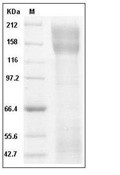 |
| 蛋白性状 | Lyophilized powder |
| 缓冲液 | Lyophilized from a solution filtered through a 0.22 μm filter, containing PBS, pH 7.4. Typically, a mixture containing 5% to 8% trehalose, mannitol, and 0.01% Tween 80 is incorporated as a protective agent before lyophilization. |
| 复溶方法 | Reconstituted with sterile deionized water to 0.25 mg/mL. Reconstitution conditions may vary depending on the lot. |
| 别名 | SPG1, S10, NCAM-L1, N-CAM-L1, N-CAML1, MIC5, MASA, L1 cell adhesion molecule, HSAS1, HSAS, CD171, CAML1 |
| 内毒素 | < 1.0 EU/μg of the protein as determined by the LAL method. |
| 分子量 | 125 kDa (predicted); 160-200 kDa (reducing condition, due to glycosylation) |
| 运输方式 | In general, lyophilized powders are shipped with blue ice, while solutions are shipped with dry ice. |
| 存储 | It is recommended to store recombinant proteins at -20°C to -80°C for future use. Lyophilized powders can be stably stored for over 12 months, while liquid products can be stored for 6-12 months at -80°C. For reconstituted protein solutions, the solution can be stored at -20°C to -80°C for at least 3 months. Please avoid multiple freeze-thaw cycles and store products in aliquots. 实际储存温度请以COA为准 |
对于不同动物的给药剂量换算,您也可以参考 更多

 嗨!有任何问题?点我咨询

版权所有©2015-2026 TargetMol Chemicals Inc.保留所有权利.
沪ICP备20019793号-4 | 沪公网安备 31010602006700号 | 沪(静)应急管危经许[2024]203441