



购物车
 您的购物车当前为空

 很棒
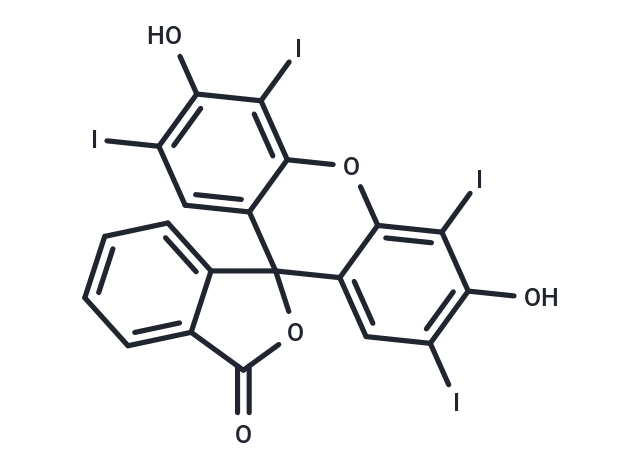
很棒Erythrosin B (Iodeosin) 是一种四碘荧光素,在某些食物(樱桃、鱼)中用作红色色素,用作某些细胞类型的染色剂,以及用作牙菌斑的披露物。其分子结构与甲状腺素相似。
很棒纯度: 98.77%
别名 藻红B, Tetraiodofluorescein, Iodeosin
Erythrosin B (Iodeosin) 是一种四碘荧光素,在某些食物(樱桃、鱼)中用作红色色素,用作某些细胞类型的染色剂,以及用作牙菌斑的披露物。其分子结构与甲状腺素相似。
| 规格 | 价格 | 库存 | 数量 |
|---|---|---|---|
| 5 mg | ¥ 143 | 现货 | |
| 10 mg | ¥ 195 | 现货 | |
| 25 mg | ¥ 297 | 现货 | |
| 50 mg | ¥ 388 | 现货 | |
| 100 mg | ¥ 698 | 现货 | |
| 500 mg | ¥ 1,120 | 现货 | |
| 1 g | ¥ 1,330 | 现货 |
TargetMol的所有产品仅用作科学研究或药证申报,不能被用于人体,我们不向个人提供产品和服务。请您遵守承诺用途,不得违反法律法规规定用于任何其他用途。

| 产品描述 | Erythrosin B (Iodeosin) , a tetraiodofluorescein, is used as a red coloring in some foods (cherries, fish), as a stain of some cell types, and as a disclosure of DENTAL PLAQUE. Its molecular structure is similar to THYROXINE. |
| 别名 | 藻红B, Tetraiodofluorescein, Iodeosin |
| 分子量 | 835.89 |
| 分子式 | C20H8I4O5 |
| CAS No. | 15905-32-5 |
| Smiles | Oc1c(I)cc2c(Oc3c(I)c(O)c(I)cc3C22OC(=O)c3ccccc23)c1I |
| 密度 | 2.4391 g/cm3 (Estimated) |
| 存储 | Powder: -20°C for 3 years | In solvent: -80°C for 1 year Shipping with blue ice/Shipping at ambient temperature. 实际储存温度请以COA为准 | ||||||||||||||||||||||||||||||
| 溶解度信息 | DMSO: 50 mg/mL (59.82 mM), Sonication is recommended.  | ||||||||||||||||||||||||||||||
溶液配制表 | |||||||||||||||||||||||||||||||
DMSO
该溶液配制表仅适用于固体产品。对于液体产品,请根据标明的浓度或密度计算稀释方案。 | |||||||||||||||||||||||||||||||
对于不同动物的给药剂量换算,您也可以参考 更多

 嗨!有任何问题?点我咨询

版权所有©2015-2026 TargetMol Chemicals Inc.保留所有权利.
沪ICP备20019793号-4 | 沪公网安备 31010602006700号 | 沪(静)应急管危经许[2024]203441