



购物车
 您的购物车当前为空

 很棒
很棒BoNT/B Protein, Clostridium botulinum, Recombinant (His) is expressed in Yeast.
很棒别名 Botulinum neurotoxin type B, botB, Bontoxilysin-B, BoNT/B
BoNT/B Protein, Clostridium botulinum, Recombinant (His) is expressed in Yeast.
| 规格 | 价格 | 库存 | 数量 |
|---|---|---|---|
| 5 μg | ¥ 922 | 3日内发货 | |
| 10 μg | ¥ 1,530 | 现货 | |
| 20 μg | ¥ 2,570 | 现货 | |
| 50 μg | ¥ 3,880 | 20日内发货 | |
| 100 μg | ¥ 5,370 | 20日内发货 | |
| 200 μg | ¥ 7,660 | 20日内发货 | |
| 500 μg | ¥ 12,300 | 20日内发货 |
TargetMol的所有产品仅用作科学研究或药证申报,不能被用于人体,我们不向个人提供产品和服务。请您遵守承诺用途,不得违反法律法规规定用于任何其他用途。
| 产品描述 | BoNT/B Protein, Clostridium botulinum, Recombinant (His) is expressed in Yeast. |
| 生物活性 | Activity has not been tested. It is theoretically active, but we cannot guarantee it. If you require protein activity, we recommend choosing the eukaryotic expression version first. |
| 研究背景 | Botulinum toxin causes flaccid paralysis by inhibiting neurotransmitter (acetylcholine) release from the presynaptic membranes of nerve terminals of the eukaryotic host skeletal and autonomic nervous system, with frequent heart or respiratory failure. Precursor of botulinum neurotoxin B which has 2 coreceptors; complex polysialylated gangliosides found on neural tissue and specific membrane-anchored proteins found in synaptic vesicles. Receptor proteins are exposed on host presynaptic cell membrane during neurotransmitter release, when the toxin heavy chain (HC) binds to them. Upon synaptic vesicle recycling the toxin is taken up via the endocytic pathway. When the pH of the toxin-containing endosome drops a structural rearrangement occurs so that the N-terminus of the HC forms pores that allows the light chain (LC) to translocate into the cytosol. Once in the cytosol the disulfide bond linking the 2 subunits is reduced and LC cleaves its target protein on synaptic vesicles, preventing their fusion with the cytoplasmic membrane and thus neurotransmitter release. Binds to host peripheral neuronal presynaptic membranes via synaptotagmins 1 and 2 (SYT1 and SYT2). Toxin binds to the membrane proximal extra-cytoplasmic region of host SYT1 and SYT2 that is transiently exposed outside of cells during exocytosis; exogenous gangliosides enhance binding and subsequent uptake of toxin into host cells. Toxin uptake into neural cells requires stimulation (incubation with K(+) to stimulate SYT protein receptor exposure); subsequently the toxin colocalizes with its receptor in host cells with a concomitant decrease in target protein (synaptobrevin-2/VAMP2) immunoreactivity. Toxin uptake can be blocked by the appropriate synaptotagmin protein fragments and gangliosides in cell culture and in mice. BoNT/B is a 'coincidence detector'; it requires simultaneous binding to coreceptor GT1b and low pH to transform into a membrane-bound, oligomeric channel. Whole toxin only has protease activity after reduction which releases LC.; Has proteolytic activity. After translocation into the eukaryotic host cytosol, inhibits neurotransmitter release by acting as a zinc endopeptidase that cleaves the '76-Gln-|-Phe-77' bond of synaptobrevin-2/VAMP2, blocking neurotransmitter release. In vitro the LC only has protease activity after reduction.; Responsible for host epithelial cell transcytosis, host nerve cell targeting and translocation of light chain (LC) into host cytosol. Composed of 3 subdomains; the translocation domain (TD), and N-terminus and C-terminus of the receptor-binding domain (RBD). The N-terminus of the TD wraps an extended belt around the perimeter of the LC; it does not seem to protect the active site, but might prevent premature LC dissociation from the translocation channel and protect toxin prior to translocation. Has 2 coreceptors; complex gangliosides found primarily on neural tissue and host synaptotagmin-1 and -2 (SYT1 and SYT2) which bind simultaneously to adjacent but separate sites at the tip of the HC. HC alone partially prevents uptake of whole toxin by neural cells, and delays paralysis onset by 160%. Binding probably positions the TD for integration into the synaptic vesicle membrane. The HC forms channels at low pH that mediate transport of the light chain (LC) from the endocytic vesicle to the cytosol. Binds gangliosides GD1b and GT1b. Gangliosides are not only a coreceptor, but also required for uptake into nerve cells. HC alone binds to host receptor proteins SYT1 and SYT2. Interaction with SYT1 protein does not require SYT1 glycosylation. The HC C-terminus (approximately residues 1079-1291) interacts with host SYT2. Has higher affinity for SYT2 than SYT1. Significantly decreases uptake and toxicity of whole BoNT/B and BoNT/G. |
| 种属 | Clostridium botulinum |
| 表达系统 | P. pastoris (Yeast) |
| 标签 | N-6xHis |
| 蛋白编号 | P10844 |
| 氨基酸序列 | MPVTINNFNYNDPIDNNNIIMMEPPFARGTGRYYKAFKITDRIWIIPERYTFGYKPEDFNKSSGIFNRDVCEYYDPDYLNTNDKKNIFLQTMIKLFNRIKSKPLGEKLLEMIINGIPYLGDRRVPLEEFNTNIASVTVNKLISNPGEVERKKGIFANLIIFGPGPVLNENETIDIGIQNHFASREGFGGIMQMKFCPEYVSVFNNVQENKGASIFNRRGYFSDPALILMHELIHVLHGLYGIKVDDLPIVPNEKKFFMQSTDAIQAEELYTFGGQDPSIITPSTDKSIYDKVLQNFRGIVDRLNKVLVCISDPNININIYKNKFKDKYKFVEDSEGKYSIDVESFDKLYKSLMFGFTETNIAENYKIKTRASYFSDSLPPVKIKNLLDNEIYTIEEGFNISDKDMEKEYRGQNKAINKQAYEEISKE |
| 蛋白构建 | 1-427 aa |
| 蛋白纯度 | > 90% as determined by SDS-PAGE. 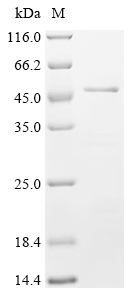 |
| 缓冲液 | Tris-based buffer, 50% glycerol |
| 复溶方法 | Reconstitute the lyophilized protein in distilled water. The product concentration should not be less than 100 μg/ml. Before opening, centrifuge the tube to collect powder at the bottom. After adding the reconstitution buffer, avoid vortexing or pipetting for mixing. |
| 别名 | Botulinum neurotoxin type B, botB, Bontoxilysin-B, BoNT/B |
| 内毒素 | < 1.0 EU/μg of the protein as determined by the LAL method. |
| 分子量 | 51.3 kDa (predicted) |
| 运输方式 | In general, lyophilized powders are shipped with blue ice, while solutions are shipped with dry ice. |
| 存储 | Lyophilized powders can be stably stored for over 12 months, while liquid products can be stored for 6-12 months at -80°C. For reconstituted protein solutions, the solution can be stored at -20°C to -80°C for at least 3 months. Please avoid multiple freeze-thaw cycles and store products in aliquots. 实际储存温度请以COA为准 |
对于不同动物的给药剂量换算,您也可以参考 更多

 嗨!有任何问题?点我咨询

版权所有©2015-2026 TargetMol Chemicals Inc.保留所有权利.
沪ICP备20019793号-4 | 沪公网安备 31010602006700号 | 沪(静)应急管危经许[2024]203441