



购物车
 您的购物车当前为空


 还可以
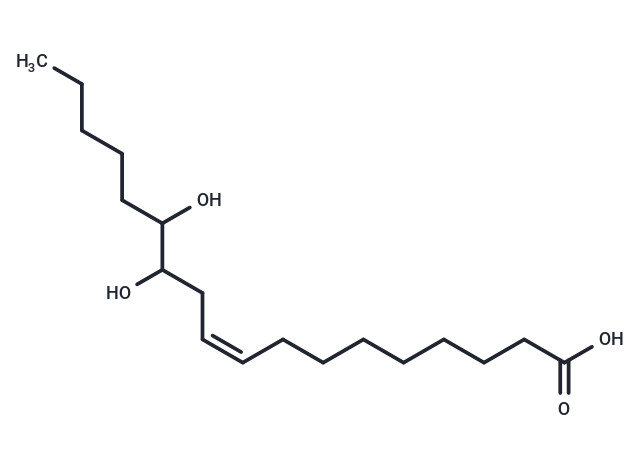
还可以(±)12(13)-DiHOME is the diol form of (±)12(13)-EpOME , a cytochrome P450-derived epoxide of linoleic acid also known as isoleukotoxin. [1] It is formed from 12(13)-EpOME by soluble epoxide hydrolase (sEH) in neutrophils. [2] 12(13)-DiHOME is toxic to Sf21 cells expressing sEH and to lacZ-expressing control cells, unlike isoleukotoxin, which is only toxic to cells containing sEH.[1] [2] Levels of 12(13)-DiHOME are increased in rat spinal cord following burn injury, and it enhances cold tolerance, increases fatty acid uptake into brown adipocytes, and decreases serum triglyceride levels in mice. Levels are also elevated in bronchoalveolar lavage fluid (BALF) in humans following exposure to biodiesel exhaust and in exhaled breath condensate in patients with allergic asthma following allergen exposure.[5] [6] Plasma levels of 12(13)-DiHOME are increased immediately following moderate-intensity exercise in mice and humans, an effect that can be prevented by brown adipose tissue removal in the mouse.[7]
还可以别名 Isoleukotoxin diol, (±)12(13)-DiHOME
(±)12(13)-DiHOME is the diol form of (±)12(13)-EpOME , a cytochrome P450-derived epoxide of linoleic acid also known as isoleukotoxin. [1] It is formed from 12(13)-EpOME by soluble epoxide hydrolase (sEH) in neutrophils. [2] 12(13)-DiHOME is toxic to Sf21 cells expressing sEH and to lacZ-expressing control cells, unlike isoleukotoxin, which is only toxic to cells containing sEH.[1] [2] Levels of 12(13)-DiHOME are increased in rat spinal cord following burn injury, and it enhances cold tolerance, increases fatty acid uptake into brown adipocytes, and decreases serum triglyceride levels in mice. Levels are also elevated in bronchoalveolar lavage fluid (BALF) in humans following exposure to biodiesel exhaust and in exhaled breath condensate in patients with allergic asthma following allergen exposure.[5] [6] Plasma levels of 12(13)-DiHOME are increased immediately following moderate-intensity exercise in mice and humans, an effect that can be prevented by brown adipose tissue removal in the mouse.[7]
| 规格 | 价格 | 库存 | 数量 |
|---|---|---|---|
| 1 mg | ¥ 22,800 | 35日内发货 |
TargetMol的所有产品仅用作科学研究或药证申报,不能被用于人体,我们不向个人提供产品和服务。请您遵守承诺用途,不得违反法律法规规定用于任何其他用途。
| 产品描述 | (±)12(13)-DiHOME is the diol form of (±)12(13)-EpOME , a cytochrome P450-derived epoxide of linoleic acid also known as isoleukotoxin. [1] It is formed from 12(13)-EpOME by soluble epoxide hydrolase (sEH) in neutrophils. [2] 12(13)-DiHOME is toxic to Sf21 cells expressing sEH and to lacZ-expressing control cells, unlike isoleukotoxin, which is only toxic to cells containing sEH.[1] [2] Levels of 12(13)-DiHOME are increased in rat spinal cord following burn injury, and it enhances cold tolerance, increases fatty acid uptake into brown adipocytes, and decreases serum triglyceride levels in mice. Levels are also elevated in bronchoalveolar lavage fluid (BALF) in humans following exposure to biodiesel exhaust and in exhaled breath condensate in patients with allergic asthma following allergen exposure.[5] [6] Plasma levels of 12(13)-DiHOME are increased immediately following moderate-intensity exercise in mice and humans, an effect that can be prevented by brown adipose tissue removal in the mouse.[7] |
| 别名 | Isoleukotoxin diol, (±)12(13)-DiHOME |
| 分子量 | 314.466 |
| 分子式 | C18H34O4 |
| CAS No. | 263399-35-5 |
| Smiles | CCCCCC(O)C(O)C\C=C/CCCCCCCC(O)=O |
| 密度 | 1.015 g/cm3 (Predicted) |
| 存储 | Powder: -20°C for 3 years | In solvent: -80°C for 1 year Shipping with blue ice/Shipping at ambient temperature. 实际储存温度请以COA为准 | ||||||||||||||||||||||||||||||
| 溶解度信息 | DMSO: 20 mg/mL (63.6 mM), Sonication is recommended. PBS (pH 7.2): 10 μg/mL, Sonication is recommended. DMF: 20 mg/mL (63.6 mM), Sonication is recommended. Ethanol: 20 mg/mL (63.6 mM), Sonication is recommended. | ||||||||||||||||||||||||||||||
溶液配制表 | |||||||||||||||||||||||||||||||
DMSO/DMF/Ethanol
该溶液配制表仅适用于固体产品。对于液体产品,请根据标明的浓度或密度计算稀释方案。 | |||||||||||||||||||||||||||||||
对于不同动物的给药剂量换算,您也可以参考 更多

 嗨!有任何问题?点我咨询

版权所有©2015-2026 TargetMol Chemicals Inc.保留所有权利.
沪ICP备20019793号-4 | 沪公网安备 31010602006700号 | 沪(静)应急管危经许[2024]203441