



购物车
 您的购物车当前为空

 很棒
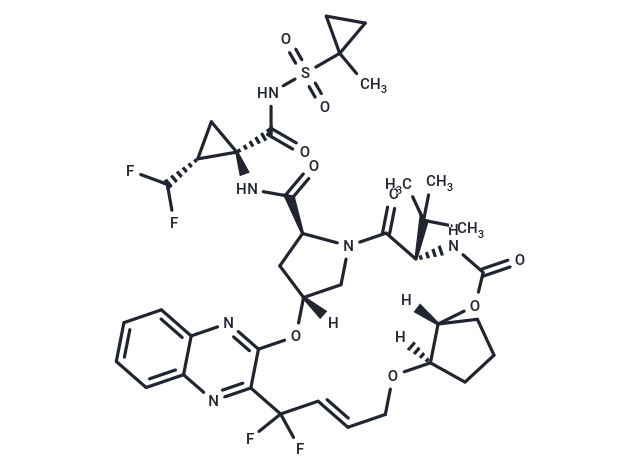
很棒Glecaprevir(ABT-493)属于小分子抑制剂,是一种HCV NS3/4A蛋白酶抑制剂(IC50=3.5–11.3 nM),同时也可抑制SARS-CoV-2 3CLpro(IC50=4.09 μM),具有口服活性和抗病毒活性,用于丙型肝炎及潜在抗冠状病毒研究。
很棒纯度: 99.33%
别名 ABT-493
Glecaprevir(ABT-493)属于小分子抑制剂,是一种HCV NS3/4A蛋白酶抑制剂(IC50=3.5–11.3 nM),同时也可抑制SARS-CoV-2 3CLpro(IC50=4.09 μM),具有口服活性和抗病毒活性,用于丙型肝炎及潜在抗冠状病毒研究。
| 规格 | 价格 | 库存 | 数量 |
|---|---|---|---|
| 2 mg | ¥ 293 | 现货 | |
| 5 mg | ¥ 453 | 现货 | |
| 10 mg | ¥ 698 | 现货 | |
| 25 mg | ¥ 1,520 | 现货 | |
| 50 mg | ¥ 2,830 | 现货 | |
| 100 mg | ¥ 4,180 | 现货 | |
| 1 mL x 10 mM (in DMSO) | ¥ 688 | 现货 |
TargetMol的所有产品仅用作科学研究或药证申报,不能被用于人体,我们不向个人提供产品和服务。请您遵守承诺用途,不得违反法律法规规定用于任何其他用途。
凭借在化合物合成方面的丰富经验,我们可以根据您的研究需求为该产品提供快速定制合成服务。
| 产品描述 | Glecaprevir (ABT-493) is a small-molecule inhibitor that functions as an HCV NS3/4A protease inhibitor (IC50=3.5–11.3 nM) and also inhibits SARS-CoV-2 3CLpro (IC50=4.09 μM). It possesses oral bioavailability and antiviral activity, and is used for the treatment of hepatitis C as well as potential anti-coronavirus research. |
| 靶点活性 | HCV NS3/4A protease:3.5-11.3 nM, 3CLpro (SARS CoV):4.09 μM, Huh7 cells:0.2 nM (EC50), the replication of stable HCV subgenomic replicons containing proteases from genotypes 1 to 6:0.21-4.6 nM (EC50) |
| 体外活性 | 方法:通过生化法测定Glecaprevir对HCV NS3/4A蛋白酶的抑制活性,并在Huh-7细胞中检测其对含不同基因型HCV蛋白酶的亚基因组复制子及临床样本复制子的抗病毒活性。结果:Glecaprevir可抑制HCV基因型1-6 NS3/4A蛋白酶,IC50值为3.5至11.3 nM;对含基因型1a、1b、2a、2b、3a、4a、5a、6a和6e蛋白酶的稳定复制子有活性,EC50值为0.21至4.6 nM,其中对最难治的基因型3复制子EC50值为1.9 nM,活性优于帕利瑞韦和格拉瑞韦;对含基因型1a、1b、2a、2b、3a、4a、4d和5a临床样本的复制子EC50中值为0.30 nM(范围0.05-3.8 nM)。[1] |
| 体内活性 | 方法:在健康志愿者和HCV感染者中,单次或多次口服Glecaprevir 300 mg(与Pibrentasvir联用),检测药代动力学参数。 |
| 激酶实验 | Eight recombinant HCV NS3/4A proteases were generated for use in evaluating glecaprevir activity in a biochemical assay. Each recombinant protein contained the entire coding regions of NS3 (amino acids 1 to 631) and NS4A (amino acids 1 to 54) from HCV genotypes 1 to 6, a 6-histidine tag at the N terminus to facilitate purification by affinity chromatography, and three lysine residues at the C terminus to increase the solubility of the protein. Genes encoding NS3/4A were derived from laboratory strains 1a-H77 and 1b-N or from clinical samples from patients infected with genotype 2a, 2b, 3a, or 4a. All patients provided written informed consent. Clinical studies were designed according to Good Clinical Practice guidelines, the Declaration of Helsinki, and applicable local regulations, with independent ethics committee or institutional review board approval for all study sites. The genotype 5a NS3/4A gene sequence was synthetically constructed based on the sequence of the clinical isolate SA13, whereas the genotype 6a NS3/4A gene sequence was synthetically constructed based on a consensus sequence derived from the alignment of 15 genotype 6a sequences available in GenBank. The NS3/4A genes were each cloned into the protein expression vector pET14b, and a clone with an NS3/4A protease sequence that matched the consensus sequence for each sample was subsequently selected for protein expression and purification. Protease activity was measured by continuous monitoring of the fluorescence change associated with the cleavage of a fluorogenic depsipeptide (EDANS/DABCYL) substrate using a purified recombinant HCV NS3/4A protease as described previously. The IC50 for each HCV protease was determined in studies in which the protease was preincubated with glecaprevir for 30 min. The percent inhibition was calculated from the initial rates of the inhibited reactions relative to the rate for the uninhibited control [1]. |
| 细胞实验 | The activity of glecaprevir, paritaprevir, or grazoprevir against cells of nine cell lines each stably transfected with an HCV subgenomic replicon containing NS3 protease from a different HCV genotype was determined using a luciferase reporter assay as described previously. Five of these nine cell lines have been described previously, including those transfected with genotypes 1a H77, 1b Con1, 3a, 4a, and 6a. The other four cell lines were established by transfecting cells with a nonchimeric genotype 2a JFH-1 replicon, two genotype 2a JFH-1 chimeric replicons containing either a genotype 2b NS3 protease domain (N-terminal 251 amino acids) or a sequence encoding full-length NS3 through the first 39 amino acids of NS5B from genotype 5a (strain SA13), and one chimeric replicon with a genotype 1b Con1 backbone containing full-length NS3 and NS4A sequences from genotype 6e. The genotype 2b and 6e NS3 sequences were each synthetically constructed based on a consensus sequence derived from the alignment of 15 genotype 2b and 4 genotype 6e sequences, respectively. All replicon constructs were bicistronic subgenomic replicons similar to those described by Bartenschlager and coworkers, and the replicon cell lines were generated by introducing these constructs into cells of an Huh-7 human hepatoma-derived cell line. The inhibitory effect of the PIs on HCV replication in replicon cells was determined in Dulbecco's modified Eagle medium containing 5% fetal bovine serum with or without 40% human plasma. The EC50s were determined using nonlinear regression curve fitting as described previously [1]. |
| 别名 | ABT-493 |
| 分子量 | 838.87 |
| 分子式 | C38H46F4N6O9S |
| CAS No. | 1365970-03-1 |
| Smiles | [H][C@@]12C[C@H](N(C1)C(=O)[C@@H](NC(=O)O[C@]1([H])CCC[C@@]1([H])OC\C=C\C(F)(F)c1nc3ccccc3nc1O2)C(C)(C)C)C(=O)N[C@@]1(C[C@H]1C(F)F)C(=O)NS(=O)(=O)C1(C)CC1 |
| 密度 | 1.46 g/cm3 (Predicted) |
| 存储 | Powder: -20°C for 3 years | In solvent: -80°C for 1 year Shipping with blue ice/Shipping at ambient temperature. 实际储存温度请以COA为准 | |||||||||||||||||||||||||||||||||||
| 溶解度信息 | DMSO: 130 mg/mL (154.97 mM), Sonication is recommended.  | |||||||||||||||||||||||||||||||||||
| 体内实验配方 | 10% DMSO+40% PEG300+5% Tween 80+45% Saline: 4 mg/mL (4.77 mM), Sonication is recommended. 请按顺序添加溶剂,在添加下一种溶剂之前,尽可能使溶液澄清。如有必要,可通过加热、超声、涡旋处理进行溶解。工作液建议现配现用。以上配方仅供参考,体内配方并不是绝对的,请根据不同情况进行调整。 | |||||||||||||||||||||||||||||||||||
溶液配制表 | ||||||||||||||||||||||||||||||||||||
DMSO
该溶液配制表仅适用于固体产品。对于液体产品,请根据标明的浓度或密度计算稀释方案。 | ||||||||||||||||||||||||||||||||||||
对于不同动物的给药剂量换算,您也可以参考 更多

 嗨!有任何问题?点我咨询

版权所有©2015-2026 TargetMol Chemicals Inc.保留所有权利.
沪ICP备20019793号-4 | 沪公网安备 31010602006700号 | 沪(静)应急管危经许[2024]203441