



购物车
 您的购物车当前为空

 很棒
很棒CXCL10 Protein, Mouse, Recombinant is expressed in E. coli expression system. The predicted molecular weight is 8.7 kDa and the accession number is P17515.
很棒纯度: 97.16%
别名 Small-inducible cytokine B10, Scyb10, Interferon-gamma induced protein CRG-2, Inp10, Ifi10, Cxcl10, C-X-C motif chemokine 10, Crg2, C7, 10 kDa interferon gamma-induced protein (Gamma-IP10;IP-10)
CXCL10 Protein, Mouse, Recombinant is expressed in E. coli expression system. The predicted molecular weight is 8.7 kDa and the accession number is P17515.
| 规格 | 价格 | 库存 | 数量 |
|---|---|---|---|
| 5 μg | ¥ 1,200 | 现货 | |
| 10 μg | ¥ 1,880 | 5日内发货 | |
| 20 μg | ¥ 2,960 | 5日内发货 | |
| 50 μg | ¥ 5,390 | 5日内发货 | |
| 100 μg | ¥ 8,580 | 20日内发货 | |
| 200 μg | ¥ 12,000 | 5日内发货 | |
| 500 μg | ¥ 19,200 | 20日内发货 |
TargetMol的所有产品仅用作科学研究或药证申报,不能被用于人体,我们不向个人提供产品和服务。请您遵守承诺用途,不得违反法律法规规定用于任何其他用途。
| 产品描述 | CXCL10 Protein, Mouse, Recombinant is expressed in E. coli expression system. The predicted molecular weight is 8.7 kDa and the accession number is P17515. |
| 生物活性 | Fully biologically active when compared to standard. The biologically active determined by a chemotaxis bioassay using human peripheral blood lymphocytes is in a concentration range of 0.1- 10.0 ng/mL in the presence of IL-2. |
| 研究背景 | (C-X-C motif) ligand (CXCL)10 (CXCL10) belongs to the ELR(-) CXC subfamily chemokine. CXCL10/IP-10 exerts its function through binding to chemokine (C-X-C motif) receptor 3 (CXCR3), a seven trans-membrane receptor coupled to G proteins. CXCL10/IP-10 and its receptor, CXCR3, appear to contribute to the pathogenesis of many autoimmune diseases, organ specific (such as type 1 diabetes, autoimmune thyroiditis, Graves' disease and ophthalmopathy), or systemic (such as rheumatoid arthritis, psoriatic arthritis, systemic lupus erythematosus, mixed cryoglobulinemia, Sjögren syndrome, or systemic sclerosis). CXCL10/IP-10 is secreted by several cell types including endothelial cells, fibroblasts, keratinocytes, thyrocytes, preadipocytes, etc. Determination of high level of CXCL10/IP-10 in peripheral fluids is therefore a marker of host immune response. |
| 种属 | Mouse |
| 表达系统 | E. coli |
| 标签 | Tag Free |
| 蛋白编号 | P17515 |
| 氨基酸序列 | IPLARTVRCN CIHIDDGPVR MRAIGKLEII PASLSCPRVE IIATMKKNDE QRCLNPESKT IKNLMKAFSQ KRSKRAP |
| 蛋白构建 | 22-98 aa |
| 蛋白纯度 | >97% as determined by SDS-PAGE. 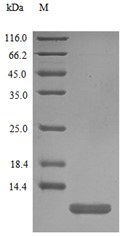 |
| 缓冲液 | 0.2 μm filtered 2×PBS, pH 7.4, lyophilized. |
| 复溶方法 | A hardcopy of COA with reconstitution instructions is sent along with the products. Please refer to it for detailed information. |
| 别名 | Small-inducible cytokine B10, Scyb10, Interferon-gamma induced protein CRG-2, Inp10, Ifi10, Cxcl10, C-X-C motif chemokine 10, Crg2, C7, 10 kDa interferon gamma-induced protein (Gamma-IP10;IP-10) |
| 内毒素 | < 1.0 EU/μg of the protein as determined by the LAL method. |
| 分子量 | 8.7 kDa as predicted |
| 密度 | no data available |
| 运输方式 | In general, lyophilized powders are shipped with blue ice, while solutions are shipped with dry ice. |
| 存储 | Lyophilized powders can be stably stored for over 12 months, while liquid products can be stored for 6-12 months at -80°C. For reconstituted protein solutions, the solution can be stored at -20°C to -80°C for at least 3 months. Please avoid multiple freeze-thaw cycles and store products in aliquots. 实际储存温度请以COA为准 |
对于不同动物的给药剂量换算,您也可以参考 更多

 嗨!有任何问题?点我咨询

版权所有©2015-2026 TargetMol Chemicals Inc.保留所有权利.
沪ICP备20019793号-4 | 沪公网安备 31010602006700号 | 沪(静)应急管危经许[2024]203441