



购物车
 您的购物车当前为空


 还可以
还可以CAMKI Protein, Mouse, Recombinant (GST) is expressed in E. coli. The accession number is Q91YS8.
还可以别名 CaMKI-alpha, CaM-KI, Camk1, CaM kinase I alpha, CaM kinase I, Calcium/calmodulin-dependent protein kinase type 1
CAMKI Protein, Mouse, Recombinant (GST) is expressed in E. coli. The accession number is Q91YS8.
| 规格 | 价格 | 库存 | 数量 |
|---|---|---|---|
| 10 μg | ¥ 8,870 | 35日内发货 |
TargetMol的所有产品仅用作科学研究或药证申报,不能被用于人体,我们不向个人提供产品和服务。请您遵守承诺用途,不得违反法律法规规定用于任何其他用途。
| 产品描述 | CAMKI Protein, Mouse, Recombinant (GST) is expressed in E. coli. The accession number is Q91YS8. |
| 生物活性 | The specific activity of CAMK1 was determined to be 169 nmol /min/mg by ADP-Glo kinase assay. 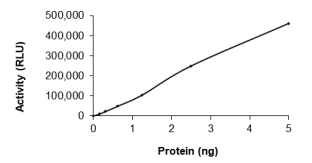 |
| 研究背景 | Calcium/calmodulin-dependent protein kinase or CaM kinases are serine/threonine-specific protein kinases that are primarily regulated by the Calcium/calmodulin complex. These kinases show a memory effect on activation. CaM kinases activity can outlast the intracellular calcium transient that is needed to activate it. Inneurons, this property is important for the induction of synaptic plasticity. Pharmacological inhibition of CaM kinases II blocks the induction of long-term potentiation. Upon activation, CaM kinases II phosphorylates postsynaptic glutamate receptors and changes the electrical properties of the synapse. Calcium/calmodulin-dependent protein kinase type 1D, also known as CaM kinase I delta, CaM kinase ID, CaMKI-like protein kinase, CKLiK and CAMK1D, is a member of theprotein kinase superfamily and CaMK subfamily. It contains oneprotein kinase domain. CAMK1D is broadly expressed. It is highly and mostly expressed in polymorphonuclear leukocytes (neutrophilic and eosinophilic granulocytes) while little or no expression is observed in monocytes and lymphocytes. Engineered overexpression of CAMK1D in non-tumorigenic breast epithelial cells led to increased cell proliferation, and molecular and phenotypic alterations indicative of epithelial-mesenchymal transition (EMT), including loss of cell-cell adhesions and increased cell migration and invasion. CAMK1D is a potential therapeutic target with particular relevance to clinically unfavorable basal-like tumors. |
| 种属 | Mouse |
| 表达系统 | E. coli |
| 标签 | N-GST |
| 蛋白编号 | Q91YS8 |
| 蛋白构建 | Recombinant full length mouse CAMK1 was expressed in E. coli cells using an N-terminal GST tag. |
| 蛋白纯度 | >90% as determined by SDS-PAGE. 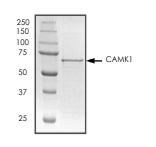 |
| 蛋白性状 | Solution |
| 缓冲液 | Supplied as sterile 50 mM Tris-HCl, pH 7.5, 150 mM NaCl, 10 mM glutathione, 0.1 mM EDTA, 0.25 mM DTT, 0.1 mM PMSF, 25% glycerol. |
| 别名 | CaMKI-alpha, CaM-KI, Camk1, CaM kinase I alpha, CaM kinase I, Calcium/calmodulin-dependent protein kinase type 1 |
| 分子量 | ~169 kDa |
| 运输方式 | Enzymes are highly recommended to be shipped at frozen temperature with dry ice. Shipment made at ambient temperature may seriously affect the activity of the ordered products. |
| 存储 | Lyophilized powders can be stably stored for over 12 months, while liquid products can be stored for 6-12 months at -80°C. For reconstituted protein solutions, the solution can be stored at -20°C to -80°C for at least 3 months. Please avoid multiple freeze-thaw cycles and store products in aliquots. 实际储存温度请以COA为准 |
对于不同动物的给药剂量换算,您也可以参考 更多

 嗨!有任何问题?点我咨询

版权所有©2015-2026 TargetMol Chemicals Inc.保留所有权利.
沪ICP备20019793号-4 | 沪公网安备 31010602006700号 | 沪(静)应急管危经许[2024]203441