



购物车
 您的购物车当前为空

 很棒
很棒INS (Insulin) is a Protein Coding gene. This gene encodes insulin, a peptide hormone that plays a vital role in the regulation of carbohydrate and lipid metabolism. After removal of the precursor signal peptide, proinsulin is post-translationally cleaved into three peptides: the B chain and A chain peptides, which are covalently linked via two disulfide bonds to form insulin, and C-peptide. The binding of insulin to the insulin receptor (INSR) stimulates glucose uptake. Diseases associated with INS include Hyperproinsulinemia and Maturity-Onset Diabetes Of The Young, Type 10. A multitude of mutant alleles with phenotypic effects has been identified, including insulin-dependent diabetes mellitus, permanent neonatal diabetes mellitus, maturity-onset diabetes of the young type 10, and hyperproinsulinemia.Cancer ImmunotherapyImmune CheckpointImmunotherapyTargeted Therapy
很棒纯度: 97.2%
别名 MODY10, IRDN, insulin, INS, ILPR, IDDM2, IDDM1, IDDM
INS (Insulin) is a Protein Coding gene. This gene encodes insulin, a peptide hormone that plays a vital role in the regulation of carbohydrate and lipid metabolism. After removal of the precursor signal peptide, proinsulin is post-translationally cleaved into three peptides: the B chain and A chain peptides, which are covalently linked via two disulfide bonds to form insulin, and C-peptide. The binding of insulin to the insulin receptor (INSR) stimulates glucose uptake. Diseases associated with INS include Hyperproinsulinemia and Maturity-Onset Diabetes Of The Young, Type 10. A multitude of mutant alleles with phenotypic effects has been identified, including insulin-dependent diabetes mellitus, permanent neonatal diabetes mellitus, maturity-onset diabetes of the young type 10, and hyperproinsulinemia.Cancer ImmunotherapyImmune CheckpointImmunotherapyTargeted Therapy
| 规格 | 价格 | 库存 | 数量 |
|---|---|---|---|
| 5 μg | ¥ 429 | 现货 | |
| 10 μg | ¥ 697 | 现货 | |
| 20 μg | ¥ 1,150 | 现货 | |
| 50 μg | ¥ 2,260 | 3日内发货 | |
| 100 μg | ¥ 3,820 | 现货 | |
| 200 μg | ¥ 6,530 | 5日内发货 | |
| 500 μg | ¥ 13,200 | 5日内发货 |
TargetMol的所有产品仅用作科学研究或药证申报,不能被用于人体,我们不向个人提供产品和服务。请您遵守承诺用途,不得违反法律法规规定用于任何其他用途。
| 产品描述 | INS (Insulin) is a Protein Coding gene. This gene encodes insulin, a peptide hormone that plays a vital role in the regulation of carbohydrate and lipid metabolism. After removal of the precursor signal peptide, proinsulin is post-translationally cleaved into three peptides: the B chain and A chain peptides, which are covalently linked via two disulfide bonds to form insulin, and C-peptide. The binding of insulin to the insulin receptor (INSR) stimulates glucose uptake. Diseases associated with INS include Hyperproinsulinemia and Maturity-Onset Diabetes Of The Young, Type 10. A multitude of mutant alleles with phenotypic effects has been identified, including insulin-dependent diabetes mellitus, permanent neonatal diabetes mellitus, maturity-onset diabetes of the young type 10, and hyperproinsulinemia.Cancer ImmunotherapyImmune CheckpointImmunotherapyTargeted Therapy |
| 生物活性 | Measured in a serum-free cell proliferation assay using MCF‑7 human breast cancer cells. The ED50 for this effect is typically 0.2-1 µg/mL. 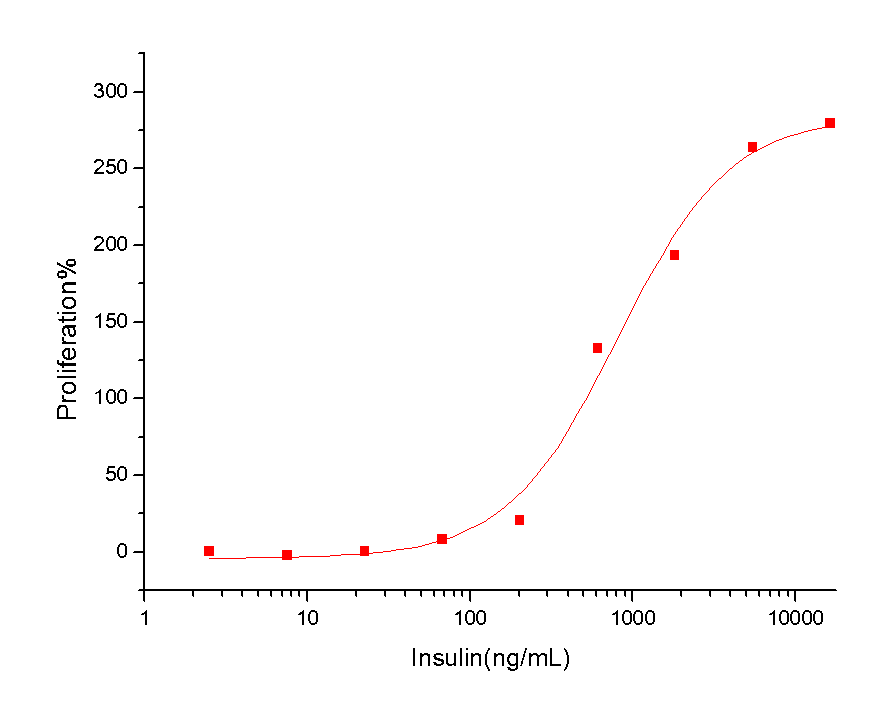 |
| 研究背景 | INS (Insulin) is a Protein Coding gene. This gene encodes insulin, a peptide hormone that plays a vital role in the regulation of carbohydrate and lipid metabolism. After removal of the precursor signal peptide, proinsulin is post-translationally cleaved into three peptides: the B chain and A chain peptides, which are covalently linked via two disulfide bonds to form insulin, and C-peptide. The binding of insulin to the insulin receptor (INSR) stimulates glucose uptake. Diseases associated with INS include Hyperproinsulinemia and Maturity-Onset Diabetes Of The Young, Type 10. A multitude of mutant alleles with phenotypic effects has been identified, including insulin-dependent diabetes mellitus, permanent neonatal diabetes mellitus, maturity-onset diabetes of the young type 10, and hyperproinsulinemia. |
| 种属 | Human |
| 表达系统 | P. pastoris (Yeast) |
| 标签 | Tag Free |
| 蛋白编号 | P01308 |
| 蛋白构建 | A DNA sequence encoding human insulin B chain (P01308)(Phe25-Lys53) and human insulin A chain (P01308)(Gly90-Asn110) was expressed with a linker AAK. Predicted N terminal: Phe |
| 蛋白纯度 | > 95% as determined by SDS-PAGE 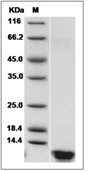 |
| 蛋白性状 | Lyophilized powder |
| 缓冲液 | Lyophilized from a solution filtered through a 0.22 μm filter, containing PBS, pH 7.4. Typically, a mixture containing 5% to 8% trehalose, mannitol, and 0.01% Tween 80 is incorporated as a protective agent before lyophilization. |
| 复溶方法 | Reconstituted with sterile deionized water to 0.13 mg/mL. Reconstitution conditions may vary depending on the lot. |
| 别名 | MODY10, IRDN, insulin, INS, ILPR, IDDM2, IDDM1, IDDM |
| 内毒素 | Please contact us for more information. |
| 分子量 | 7.1 kDa (predicted); 6 kDa (reducing conditions) |
| 运输方式 | In general, lyophilized powders are shipped with blue ice, while solutions are shipped with dry ice. |
| 存储 | It is recommended to store recombinant proteins at -20°C to -80°C for future use. Lyophilized powders can be stably stored for over 12 months, while liquid products can be stored for 6-12 months at -80°C. For reconstituted protein solutions, the solution can be stored at -20°C to -80°C for at least 3 months. Please avoid multiple freeze-thaw cycles and store products in aliquots. 实际储存温度请以COA为准 |
对于不同动物的给药剂量换算,您也可以参考 更多

 嗨!有任何问题?点我咨询

版权所有©2015-2026 TargetMol Chemicals Inc.保留所有权利.
沪ICP备20019793号-4 | 沪公网安备 31010602006700号 | 沪(静)应急管危经许[2024]203441