



购物车
 您的购物车当前为空

 很棒
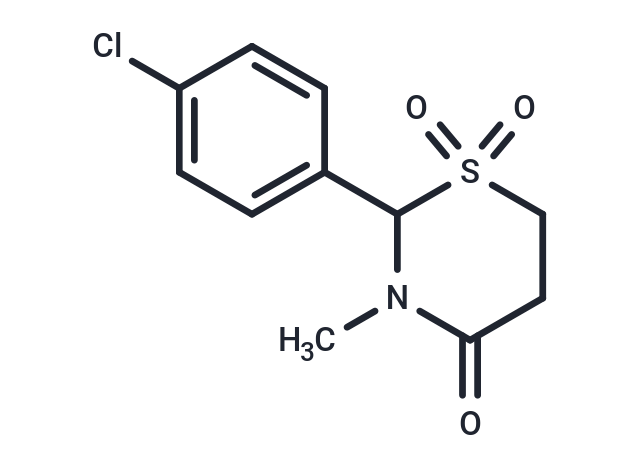
很棒Chlormezanone (Trancopal) 是一种非苯二氮卓类药物,用于治疗焦虑症和肌肉痉挛。
很棒纯度: 99.93%
别名 氯美扎酮, 芬那露, Trancopal
Chlormezanone (Trancopal) 是一种非苯二氮卓类药物,用于治疗焦虑症和肌肉痉挛。
| 规格 | 价格 | 库存 | 数量 |
|---|---|---|---|
| 10 mg | ¥ 129 | 现货 | |
| 25 mg | ¥ 189 | 现货 | |
| 50 mg | ¥ 263 | 现货 | |
| 100 mg | ¥ 348 | 现货 | |
| 200 mg | ¥ 515 | 现货 | |
| 1 mL x 10 mM (in DMSO) | ¥ 143 | 现货 |
TargetMol的所有产品仅用作科学研究或药证申报,不能被用于人体,我们不向个人提供产品和服务。请您遵守承诺用途,不得违反法律法规规定用于任何其他用途。

| 产品描述 | Chlormezanone (Trancopal) is a non-benzodiazepine that is used in the management of anxiety. It has been suggested for use in the treatment of muscle spasm. |
| 别名 | 氯美扎酮, 芬那露, Trancopal |
| 分子量 | 273.74 |
| 分子式 | C11H12ClNO3S |
| CAS No. | 80-77-3 |
| Smiles | CN1C(c2ccc(Cl)cc2)S(=O)(=O)CCC1=O |
| 密度 | 1.2205 g/cm3 (Estimated) |
| 存储 | Keep away from moisture Powder: -20°C for 3 years | In solvent: -80°C for 1 year Shipping with blue ice/Shipping at ambient temperature. 实际储存温度请以COA为准 | ||||||||||||||||||||||||||||||||||||||||
| 溶解度信息 | Ethanol: 6.8 mg/mL (24.84 mM), Sonication is recommended. DMSO: 27.4 mg/mL (100.09 mM), Sonication is recommended. | ||||||||||||||||||||||||||||||||||||||||
| 体内实验配方 | 10% DMSO+40% PEG300+5% Tween 80+45% Saline: 2.5 mg/mL (9.13 mM), Sonication is recommended. 请按顺序添加溶剂,在添加下一种溶剂之前,尽可能使溶液澄清。如有必要,可通过加热、超声、涡旋处理进行溶解。工作液建议现配现用。以上配方仅供参考,体内配方并不是绝对的,请根据不同情况进行调整。 | ||||||||||||||||||||||||||||||||||||||||
溶液配制表 | |||||||||||||||||||||||||||||||||||||||||
Ethanol/DMSO
DMSO
该溶液配制表仅适用于固体产品。对于液体产品,请根据标明的浓度或密度计算稀释方案。 | |||||||||||||||||||||||||||||||||||||||||
对于不同动物的给药剂量换算,您也可以参考 更多

 嗨!有任何问题?点我咨询

版权所有©2015-2026 TargetMol Chemicals Inc.保留所有权利.
沪ICP备20019793号-4 | 沪公网安备 31010602006700号 | 沪(静)应急管危经许[2024]203441