3-Acetylcoumarin demonstrates a variety of bioactivities across multiple biological systems. It induces NAD(P)H quinone reductase activity in Hepa 1c1c7 murine hepatoma cells at a concentration of 200.0 µM, suggesting antioxidant properties. The compound exhibits DPPH radical scavenging activity of 0.83% at 25 µg/mL after 30 minutes and shows ABTS free radical inhibition by 63.58%. Moreover, it inhibits rat intestinal alpha-glucosidase by 53.19% at 100 µg/mL and displays inhibitory activity against Human Jumonji Domain Containing 2E (JMJD2E) with a potency of 10,000.0 nM. Additionally, 3-Acetylcoumarin acts in a cytochrome panel assay with an AC50 of 199.53 nM and inhibits human recombinant MAO-B with an IC50 value of 14,450.0 nM, showing selectivity over MAO-A.
In cancer research, it inhibits growth in various human tumor cell lines with GI50 values between 36,224.3 nM and 100,000.0 nM across different cancer types such as breast, melanoma, lung, prostate, colon, leukemia, central nervous system, ovarian, and renal cells. The compound also protects against pesticide-induced gastric lesions in Swiss albino mice, reducing lesions by 66.0% at a dose of 20 mg/kg orally. It shows moderate inhibitory activity against human CA9 with a Ki value of 151.8 nM and strong inhibitory activity against human CA12 with a Ki value of 7.8 nM.
3-Acetylcoumarin also inhibits the aggregation of HFIP-induced amyloid beta (1-42 residues), with inhibition rates between 40.0% to 59.0%, as measured by ThT fluorescence and turbidity assays. It demonstrates cytotoxicity against human SH-SY5Y cells with an IC50 of 75,000.0 nM and neuroprotective effects against amyloid beta-induced toxicity in the same cells with an activity level of 77.0%. Additionally, the compound shows antiviral activity against SARS-CoV-2 in VERO-6 cells, although with an IC50 value greater than 20,000.0 nM, it may not be highly potent in this assay..
Note: Summary generated by AI. Data source: ChEMBL 




 您的购物车当前为空
 很棒
很棒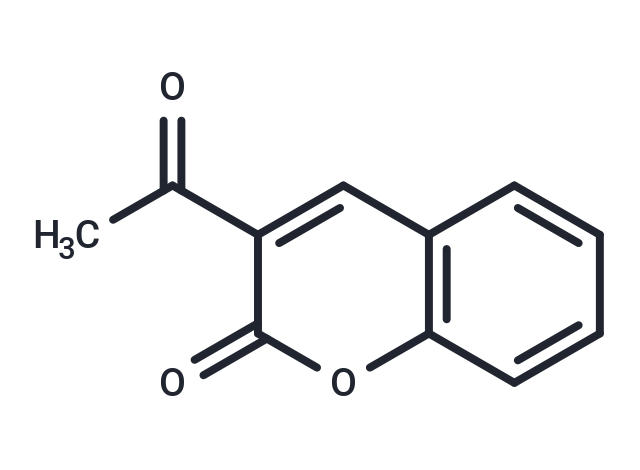


 嗨!有任何问题?点我咨询

 | 沪(静)应急管危经许[2024]203441