



购物车
 您的购物车当前为空


 还可以
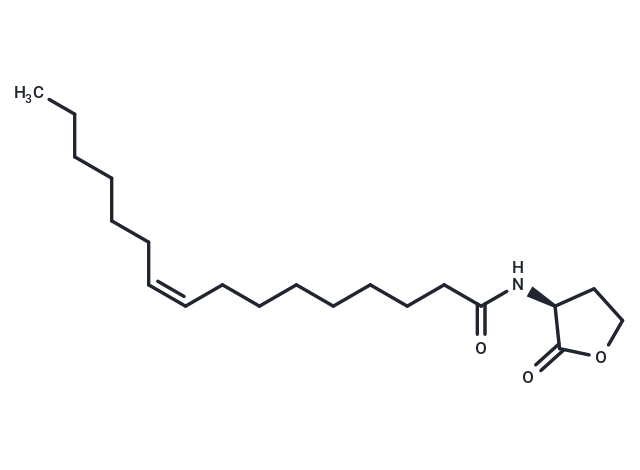
还可以Quorum sensing is a regulatory process used by bacteria for controlling gene expression in response to increasing cell density.[1] This regulatory process manifests itself with a variety of phenotypes including biofilm formation and virulence factor production.[2] Coordinated gene expression is achieved by the production, release, and detection of small diffusible signal molecules called autoinducers. The N-acylated homoserine lactones (AHLs) comprise one such class of autoinducers, each of which generally consists of a fatty acid coupled with homoserine lactone (HSL). AHLs vary in acyl group length (C4-C18), in the substitution of C3 (hydrogen, hydroxyl, or oxo group) and in the presence or absence of one or more carbon-carbon double bonds in the fatty acid chain. These differences confer signal specificity through the affinity of transcriptional regulators of the LuxR family.[3] C16:1-Δ9-(L)-HSL is a long-chain AHL that functions as a quorum sensing signaling molecule in strains of S. meliloti.[4],[5],[6],[7] Regulating bacterial quorum sensing signaling can be used to inhibit pathogenesis and thus, represents a new approach to antimicrobial therapy in the treatment of infectious diseases.[8]
还可以别名 N-cis-hexadec-9Z-enoyl-L-Homoserine lactone, N-(2-oxotetrahydrofuran-3S-yl) Palmitoleyl Amide
Quorum sensing is a regulatory process used by bacteria for controlling gene expression in response to increasing cell density.[1] This regulatory process manifests itself with a variety of phenotypes including biofilm formation and virulence factor production.[2] Coordinated gene expression is achieved by the production, release, and detection of small diffusible signal molecules called autoinducers. The N-acylated homoserine lactones (AHLs) comprise one such class of autoinducers, each of which generally consists of a fatty acid coupled with homoserine lactone (HSL). AHLs vary in acyl group length (C4-C18), in the substitution of C3 (hydrogen, hydroxyl, or oxo group) and in the presence or absence of one or more carbon-carbon double bonds in the fatty acid chain. These differences confer signal specificity through the affinity of transcriptional regulators of the LuxR family.[3] C16:1-Δ9-(L)-HSL is a long-chain AHL that functions as a quorum sensing signaling molecule in strains of S. meliloti.[4],[5],[6],[7] Regulating bacterial quorum sensing signaling can be used to inhibit pathogenesis and thus, represents a new approach to antimicrobial therapy in the treatment of infectious diseases.[8]
| 规格 | 价格 | 库存 | 数量 |
|---|---|---|---|
| 5 mg | ¥ 1,080 | 35日内发货 | |
| 10 mg | ¥ 2,130 | 35日内发货 | |
| 25 mg | ¥ 4,880 | 35日内发货 | |
| 50 mg | ¥ 8,630 | 35日内发货 |
TargetMol的所有产品仅用作科学研究或药证申报,不能被用于人体,我们不向个人提供产品和服务。请您遵守承诺用途,不得违反法律法规规定用于任何其他用途。
| 产品描述 | Quorum sensing is a regulatory process used by bacteria for controlling gene expression in response to increasing cell density.[1] This regulatory process manifests itself with a variety of phenotypes including biofilm formation and virulence factor production.[2] Coordinated gene expression is achieved by the production, release, and detection of small diffusible signal molecules called autoinducers. The N-acylated homoserine lactones (AHLs) comprise one such class of autoinducers, each of which generally consists of a fatty acid coupled with homoserine lactone (HSL). AHLs vary in acyl group length (C4-C18), in the substitution of C3 (hydrogen, hydroxyl, or oxo group) and in the presence or absence of one or more carbon-carbon double bonds in the fatty acid chain. These differences confer signal specificity through the affinity of transcriptional regulators of the LuxR family.[3] C16:1-Δ9-(L)-HSL is a long-chain AHL that functions as a quorum sensing signaling molecule in strains of S. meliloti.[4],[5],[6],[7] Regulating bacterial quorum sensing signaling can be used to inhibit pathogenesis and thus, represents a new approach to antimicrobial therapy in the treatment of infectious diseases.[8] |
| 别名 | N-cis-hexadec-9Z-enoyl-L-Homoserine lactone, N-(2-oxotetrahydrofuran-3S-yl) Palmitoleyl Amide |
| 分子量 | 337.504 |
| 分子式 | C20H35NO3 |
| CAS No. | 479050-94-7 |
| Smiles | CCCCCC\C=C/CCCCCCCC(=O)N[C@H]1CCOC1=O |
| 密度 | no data available |
| 存储 | Powder: -20°C for 3 years | In solvent: -80°C for 1 year Shipping with blue ice/Shipping at ambient temperature. 实际储存温度请以COA为准 | ||||||||||||||||||||||||||||||
| 溶解度信息 | DMF: 20 mg/mL (59.26 mM), Sonication is recommended. DMSO: 20 mg/mL (59.26 mM), Sonication is recommended. | ||||||||||||||||||||||||||||||
溶液配制表 | |||||||||||||||||||||||||||||||
DMF/DMSO
该溶液配制表仅适用于固体产品。对于液体产品,请根据标明的浓度或密度计算稀释方案。 | |||||||||||||||||||||||||||||||
对于不同动物的给药剂量换算,您也可以参考 更多

 嗨!有任何问题?点我咨询

版权所有©2015-2026 TargetMol Chemicals Inc.保留所有权利.
沪ICP备20019793号-4 | 沪公网安备 31010602006700号 | 沪(静)应急管危经许[2024]203441