

购物车
 您的购物车当前为空

 很棒
很棒TIM-3/KIM-3/HAVCR2 Protein, Human, Recombinant (His) is expressed in HEK293 mammalian cells with His tag. The predicted molecular weight is 21.3 kDa and the accession number is AAL65157.1.
很棒纯度: 95.4%
别名 TIMD-3, TIMD3, Tim-3, TIM3, KIM-3, hepatitis A virus cellular receptor 2, HAVcr-2, HAVCR2, CD366
TIM-3/KIM-3/HAVCR2 Protein, Human, Recombinant (His) is expressed in HEK293 mammalian cells with His tag. The predicted molecular weight is 21.3 kDa and the accession number is AAL65157.1.
| 规格 | 价格 | 库存 | 数量 |
|---|---|---|---|
| 5 μg | ¥ 317 | 现货 | |
| 10 μg | ¥ 493 | 3日内发货 | |
| 20 μg | ¥ 823 | 现货 | |
| 50 μg | ¥ 1,580 | 现货 | |
| 100 μg | ¥ 2,700 | 现货 | |
| 200 μg | ¥ 4,780 | 5日内发货 | |
| 500 μg | ¥ 9,790 | 5日内发货 | |
| 1 mg | ¥ 16,900 | 5日内发货 |
| 产品描述 | TIM-3/KIM-3/HAVCR2 Protein, Human, Recombinant (His) is expressed in HEK293 mammalian cells with His tag. The predicted molecular weight is 21.3 kDa and the accession number is AAL65157.1. |
| 生物活性 | Captured Anti-TIM-3 Mab (Human IgG4) on proA Chip can bind TIM-3 with an affinity constant of 2.351 nM as determined in a SPR assay (QC tested). 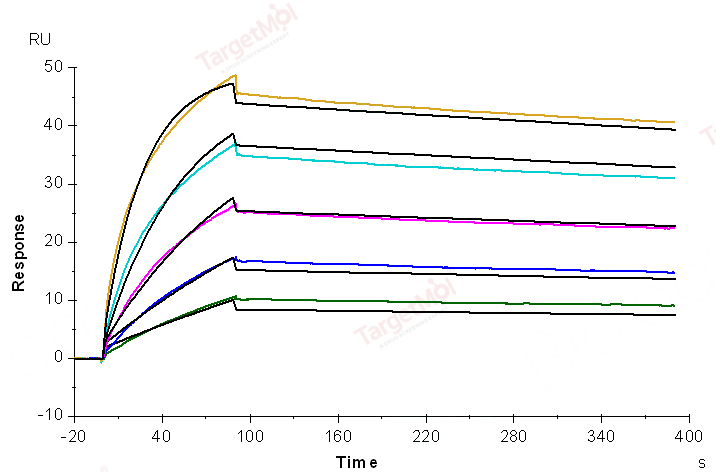 |
| 研究背景 | Hepatitis A virus cellular receptor 2 (HAVCR2), formerly known as T cell immunoglobulin and mucin domain-3 (TIM-3), is a transmembrane glycoprotein expressed on the surface of terminally differentiated Th1 cells but not on Th2 cells. It was the first surface molecule that specifically identifies Th1 cells in both the mouse and human. Recently, the identification of Galectin-9 as a ligand for TIM-3 has established the TIM-3-Galectin-9 pathway as an important regulator of Th1 immunity and tolerance induction. Engagement of Tim-3 by its ligand galectin-9 negatively regulates IFN-gamma secretion and influences the ability to induce T cell tolerance in both mice and man. It suggests a novel paradigm in which dysregulation of the TIM-3-galectin-9 pathway could underlie chronic autoimmune disease states, such as multiple sclerosis. Recent work has explored the role of TIM-3 in systemic lupus erythematosus (SLE), and their results indicate that TIM-3 may represent a novel target for the treatment of SLE. Numerous studies have demonstrated that Tim-3 influences autoimmune diseases, including diabetes and multiple sclerosis, and its role in other inflammatory diseases including allergies and cancer is beginning to become clear. In the tumor rejection model, the soluble form of Tim-3 (sTim-3) significantly impaired T cell antitumor immunity, evidenced by decreased antitumor CTL activity and reduced amount of tumor-infiltrating lymphocytes in the tumor. sTim-3 as an immunoregulatory molecule that may be involved in the negative regulation of T cell-mediated immune response.Cancer ImmunotherapyCo-inhibitory Immune Checkpoint TargetsImmune CheckpointImmune Checkpoint Detection: ELISA AntibodiesImmune Checkpoint Detection: IP AntibodiesImmune Checkpoint Detection: WB AntibodiesImmune Checkpoint ProteinsImmune Checkpoint TargetsImmunotherapyTargeted Therapy |
| 种属 | Human |
| 表达系统 | HEK293 Cells |
| 标签 | C-His |
| 蛋白编号 | AAL65157.1 |
| 蛋白构建 | A DNA sequence encoding the human HAVCR2 ( AAL65157.1) (Met1-Arg200) was expressed with a polyhistidine tag at the C-terminus. Predicted N terminal: Ser 22 |
| 蛋白纯度 | ≥ 95 % as determined by SDS-PAGE. ≥ 95 % as determined by SEC-HPLC. 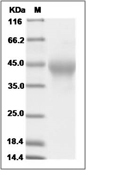 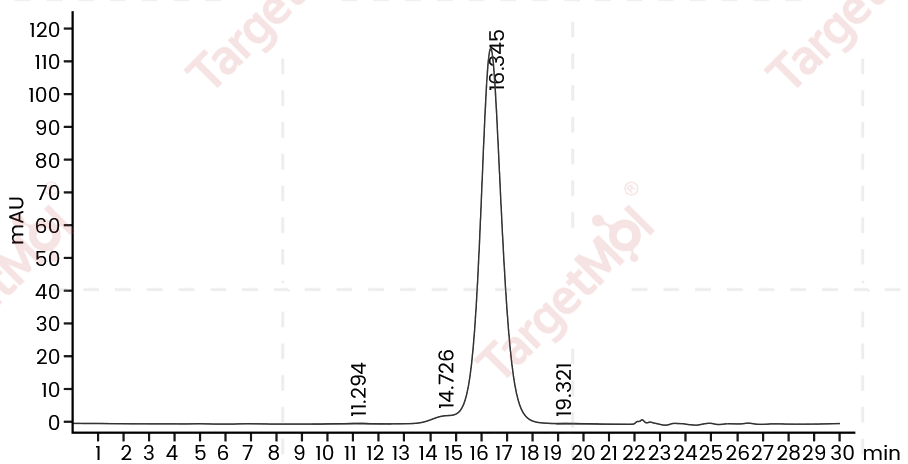 |
| 蛋白性状 | Lyophilized powder |
| 缓冲液 | Lyophilized from a solution filtered through a 0.22 μm filter, containing PBS, pH 7.4. Typically, a mixture containing 5% to 8% trehalose, mannitol, and 0.01% Tween 80 is incorporated as a protective agent before lyophilization. |
| 复溶方法 | Reconstituted with sterile deionized water to 0.25 mg/mL. Reconstitution conditions may vary depending on the lot. |
| 别名 | TIMD-3, TIMD3, Tim-3, TIM3, KIM-3, hepatitis A virus cellular receptor 2, HAVcr-2, HAVCR2, CD366 |
| 内毒素 | < 1.0 EU/μg of the protein as determined by the LAL method. |
| 分子量 | 21.3 kDa (predicted); 42.8 kDa (reducing condition, due to glycosylation) |
| 运输方式 | In general, lyophilized powders are shipped with blue ice, while solutions are shipped with dry ice. |
| 存储 |
对于不同动物的给药剂量换算,您也可以参考 更多

 嗨!有任何问题?点我咨询

版权所有©2015-2026 TargetMol Chemicals Inc.保留所有权利.
沪ICP备20019793号-4 | 沪公网安备 31010602006700号 | 沪(静)应急管危经许[2024]203441