



购物车
 您的购物车当前为空


 还可以
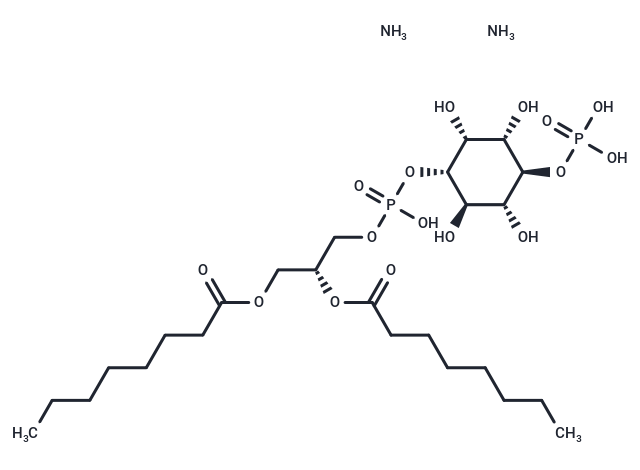
还可以The phosphatidylinositol (PtdIns) phosphates represent a small percentage of total membrane phospholipids. However, they play a critical role in the generation and transmission of cellular signals. PtdIns-(4)-P1 (1,2-dioctanoyl) is a synthetic analog of natural phosphatidylinositol (PtdIns) featuring C8:0 fatty acids at the sn-1 and sn-2 positions. The compound contains the same inositol and diacylglycerol (DAG) stereochemistry as the natural compound. PtdIns-(4)-P1 can be phosphorylated to di- (PtdIns-P2; PIP2) and triphosphates (PtdIns-P3; PIP3). Hydrolysis of PtdIns-(4,5)-P2 by phosphoinositide (PI)-specific phospholipase C generates inositol triphosphate (IP3) and DAG which are key second messengers in an intricate biochemical signal transduction cascade.
还可以别名 PtdIns-(4)-P1 (1,2-dioctanoyl) (ammonium salt)
The phosphatidylinositol (PtdIns) phosphates represent a small percentage of total membrane phospholipids. However, they play a critical role in the generation and transmission of cellular signals. PtdIns-(4)-P1 (1,2-dioctanoyl) is a synthetic analog of natural phosphatidylinositol (PtdIns) featuring C8:0 fatty acids at the sn-1 and sn-2 positions. The compound contains the same inositol and diacylglycerol (DAG) stereochemistry as the natural compound. PtdIns-(4)-P1 can be phosphorylated to di- (PtdIns-P2; PIP2) and triphosphates (PtdIns-P3; PIP3). Hydrolysis of PtdIns-(4,5)-P2 by phosphoinositide (PI)-specific phospholipase C generates inositol triphosphate (IP3) and DAG which are key second messengers in an intricate biochemical signal transduction cascade.
| 规格 | 价格 | 库存 | 数量 |
|---|---|---|---|
| 100 μg | ¥ 1,590 | 35日内发货 | |
| 500 μg | ¥ 6,970 | 35日内发货 | |
| 1 mg | ¥ 12,300 | 35日内发货 |
TargetMol的所有产品仅用作科学研究或药证申报,不能被用于人体,我们不向个人提供产品和服务。请您遵守承诺用途,不得违反法律法规规定用于任何其他用途。
| 产品描述 | The phosphatidylinositol (PtdIns) phosphates represent a small percentage of total membrane phospholipids. However, they play a critical role in the generation and transmission of cellular signals. PtdIns-(4)-P1 (1,2-dioctanoyl) is a synthetic analog of natural phosphatidylinositol (PtdIns) featuring C8:0 fatty acids at the sn-1 and sn-2 positions. The compound contains the same inositol and diacylglycerol (DAG) stereochemistry as the natural compound. PtdIns-(4)-P1 can be phosphorylated to di- (PtdIns-P2; PIP2) and triphosphates (PtdIns-P3; PIP3). Hydrolysis of PtdIns-(4,5)-P2 by phosphoinositide (PI)-specific phospholipase C generates inositol triphosphate (IP3) and DAG which are key second messengers in an intricate biochemical signal transduction cascade. |
| 别名 | PtdIns-(4)-P1 (1,2-dioctanoyl) (ammonium salt) |
| 分子量 | 700.653 |
| 分子式 | C25H54N2O16P2 |
| CAS No. | 1246303-11-6 |
| Smiles | N.N.CCCCCCCC(=O)OC[C@H](COP(O)(=O)O[C@@H]1[C@H](O)[C@H](O)[C@@H](OP(O)(O)=O)[C@H](O)[C@H]1O)OC(=O)CCCCCCC |
| 存储 | Powder: -20°C for 3 years | In solvent: -80°C for 1 year Shipping with blue ice/Shipping at ambient temperature. 实际储存温度请以COA为准 |
| 溶解度信息 | DMSO: Soluble |
对于不同动物的给药剂量换算,您也可以参考 更多

 嗨!有任何问题?点我咨询

版权所有©2015-2026 TargetMol Chemicals Inc.保留所有权利.
沪ICP备20019793号-4 | 沪公网安备 31010602006700号 | 沪(静)应急管危经许[2024]203441