













购物车
- 全部删除
 您的购物车当前为空

PTGS2, also known as COX-2, is s component of Prostaglandin-endoperoxide synthase (PTGS). PTGS, also known as cyclooxygenase, is the key enzyme in prostaglandin biosynthesis, and acts both as a dioxygenase and as a peroxidase. There are two isozymes of PTGS: a constitutive PTGS1 and an inducible PTGS2, which differ in their regulation of expression and tissue distribution. PTGS2 is overexpressed in many cancers. The overexpression of PTGS2 along with increased angiogenesis and GLUT-1 expression is significantly associated with gallbladder carcinomas. Furthermore the product of COX-2, PGH2 is converted by prostaglandin E2 synthase into PGE2, which in turn can stimulate cancer progression. Consequently inhibiting COX-2 may have benefit in the prevention and treatment of these types of cancer. PTGS2 is regulated by specific stimulatory events, suggesting that it is responsible for the prostanoid biosynthesis involved in inflammation and mitogenesis. It mediates the formation of prostaglandins from arachidonate and may have a role as a major mediator of inflammation and/or a role for prostanoid signaling in activity-dependent plasticity.Cancer ImmunotherapyImmune CheckpointImmunotherapyTargeted Therapy
| 规格 | 价格 | 库存 | 数量 |
|---|---|---|---|
| 50 μg | ¥ 3,820 | In stock | |
| 100 μg | ¥ 6,530 | 5日内发货 | |
| 200 μg | ¥ 11,130 | 5日内发货 | |
| 500 μg | ¥ 22,510 | 5日内发货 |
| 生物活性 | Activity testing is in progress. It is theoretically active, but we cannot guarantee it. If you require protein activity, we recommend choosing the eukaryotic expression version first. |
| 产品描述 | PTGS2, also known as COX-2, is s component of Prostaglandin-endoperoxide synthase (PTGS). PTGS, also known as cyclooxygenase, is the key enzyme in prostaglandin biosynthesis, and acts both as a dioxygenase and as a peroxidase. There are two isozymes of PTGS: a constitutive PTGS1 and an inducible PTGS2, which differ in their regulation of expression and tissue distribution. PTGS2 is overexpressed in many cancers. The overexpression of PTGS2 along with increased angiogenesis and GLUT-1 expression is significantly associated with gallbladder carcinomas. Furthermore the product of COX-2, PGH2 is converted by prostaglandin E2 synthase into PGE2, which in turn can stimulate cancer progression. Consequently inhibiting COX-2 may have benefit in the prevention and treatment of these types of cancer. PTGS2 is regulated by specific stimulatory events, suggesting that it is responsible for the prostanoid biosynthesis involved in inflammation and mitogenesis. It mediates the formation of prostaglandins from arachidonate and may have a role as a major mediator of inflammation and/or a role for prostanoid signaling in activity-dependent plasticity.Cancer ImmunotherapyImmune CheckpointImmunotherapyTargeted Therapy |
| 种属 | Human |
| 表达系统 | Baculovirus Insect Cells |
| 标签 | C-His |
| 蛋白编号 | P35354 |
| 别名 | prostaglandin-endoperoxide synthase 2,PHS-2,PGHS-2,PGG/HS,hCox-2,GRIPGHS,COX-2,COX2 |
| 蛋白构建 | A DNA sequence encoding the human PTGS2 (NP_000954.1) (Met 1-Leu 604) was fused with a polyhistidine tag at the C-terminus. Predicted N terminal: Ala 18 |
| 蛋白纯度 | > 90 % as determined by SDS-PAGE 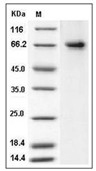 |
| 分子量 | 68.5 kDa (predicted); 66 kDa (reducing conditions) |
| 内毒素 | < 1.0 EU/μg of the protein as determined by the LAL method. |
| 缓冲液 | Lyophilized from a solution filtered through a 0.22 μm filter, containing 50 mM Tris, 100 mM NaCl, 0.5 mM PMSF, 10% glycerol, pH 8.0.Typically, a mixture containing 5% to 8% trehalose, mannitol, and 0.01% Tween 80 is incorporated as a protective agent before lyophilization. |
| 复溶方法 | A Certificate of Analysis (CoA) containing reconstitution instructions is included with the products. Please refer to the CoA for detailed information. |
| 存储 | It is recommended to store recombinant proteins at -20°C to -80°C for future use. Lyophilized powders can be stably stored for over 12 months, while liquid products can be stored for 6-12 months at -80°C. For reconstituted protein solutions, the solution can be stored at -20°C to -80°C for at least 3 months. Please avoid multiple freeze-thaw cycles and store products in aliquots. |
| 运输方式 | In general, Lyophilized powders are shipping with blue ice. |
| 研究背景 | PTGS2, also known as COX-2, is s component of Prostaglandin-endoperoxide synthase (PTGS). PTGS, also known as cyclooxygenase, is the key enzyme in prostaglandin biosynthesis, and acts both as a dioxygenase and as a peroxidase. There are two isozymes of PTGS: a constitutive PTGS1 and an inducible PTGS2, which differ in their regulation of expression and tissue distribution. PTGS2 is overexpressed in many cancers. The overexpression of PTGS2 along with increased angiogenesis and GLUT-1 expression is significantly associated with gallbladder carcinomas. Furthermore the product of COX-2, PGH2 is converted by prostaglandin E2 synthase into PGE2, which in turn can stimulate cancer progression. Consequently inhibiting COX-2 may have benefit in the prevention and treatment of these types of cancer. PTGS2 is regulated by specific stimulatory events, suggesting that it is responsible for the prostanoid biosynthesis involved in inflammation and mitogenesis. It mediates the formation of prostaglandins from arachidonate and may have a role as a major mediator of inflammation and/or a role for prostanoid signaling in activity-dependent plasticity.Cancer ImmunotherapyImmune CheckpointImmunotherapyTargeted Therapy |

 嗨!有任何问题?点我咨询