您的购物车当前为空
别名 FXI, coagulation factor XI, coagulation factor 11
Factor XI (plasma thromboplastin antecedent) is a plasma glycoprotein, and a zymogen acting as a serine protease which participates in blood coagulation as a catalyst in the conversion of factor IX to factor IXa in the presence of calcium ions. It is an unusual dimeric protease, with structural features that distinguish it from vitamin K-dependent coagulation proteases. The factor XI is synthesized in the liver as a single polypeptide chain with a molecular weight estimated between 125 ~160 kDa and then is processed into a disulfide-bond linked homodimer. FXI is a homodimer, with each subunit containing four apple domains and a protease domain. The apple domains form a disk structure with binding sites for platelets, high molecular weight kininogen, and the substrate factor IX (FIX). FXI is converted to the active protease FXIa by cleavage of the Arg369-Ile370 bond on each subunit. After the activation reaction, Factor XIa is composed of two heavy and two light chains held together by three disulfide bonds. The heavy chains are derived from the amino termini of the zymogen and responsible for the binding of factor XI to high molecular weight kininogen and for the activation of factor IX, while the light chain contains the catalytic portion of the enzyme and is homologous to the trypsin family of serine proteases. FXI deficiency is a disorder characterized by a mild or no bleeding tendency. Severe FXI deficiency is an injury-related bleeding disorder common in Ashkenazi Jews and rare worldwide.

Factor XI (plasma thromboplastin antecedent) is a plasma glycoprotein, and a zymogen acting as a serine protease which participates in blood coagulation as a catalyst in the conversion of factor IX to factor IXa in the presence of calcium ions. It is an unusual dimeric protease, with structural features that distinguish it from vitamin K-dependent coagulation proteases. The factor XI is synthesized in the liver as a single polypeptide chain with a molecular weight estimated between 125 ~160 kDa and then is processed into a disulfide-bond linked homodimer. FXI is a homodimer, with each subunit containing four apple domains and a protease domain. The apple domains form a disk structure with binding sites for platelets, high molecular weight kininogen, and the substrate factor IX (FIX). FXI is converted to the active protease FXIa by cleavage of the Arg369-Ile370 bond on each subunit. After the activation reaction, Factor XIa is composed of two heavy and two light chains held together by three disulfide bonds. The heavy chains are derived from the amino termini of the zymogen and responsible for the binding of factor XI to high molecular weight kininogen and for the activation of factor IX, while the light chain contains the catalytic portion of the enzyme and is homologous to the trypsin family of serine proteases. FXI deficiency is a disorder characterized by a mild or no bleeding tendency. Severe FXI deficiency is an injury-related bleeding disorder common in Ashkenazi Jews and rare worldwide.
| 规格 | 价格 | 库存 | 数量 |
|---|---|---|---|
| 5 μg | ¥ 791 | 3日内发货 | |
| 10 μg | ¥ 1,330 | 3日内发货 | |
| 20 μg | ¥ 2,230 | 3日内发货 | |
| 50 μg | ¥ 4,470 | 现货 | |
| 100 μg | ¥ 7,630 | 5日内发货 | |
| 200 μg | ¥ 13,000 | 5日内发货 | |
| 500 μg | ¥ 26,200 | 5日内发货 |
| 产品描述 | Factor XI (plasma thromboplastin antecedent) is a plasma glycoprotein, and a zymogen acting as a serine protease which participates in blood coagulation as a catalyst in the conversion of factor IX to factor IXa in the presence of calcium ions. It is an unusual dimeric protease, with structural features that distinguish it from vitamin K-dependent coagulation proteases. The factor XI is synthesized in the liver as a single polypeptide chain with a molecular weight estimated between 125 ~160 kDa and then is processed into a disulfide-bond linked homodimer. FXI is a homodimer, with each subunit containing four apple domains and a protease domain. The apple domains form a disk structure with binding sites for platelets, high molecular weight kininogen, and the substrate factor IX (FIX). FXI is converted to the active protease FXIa by cleavage of the Arg369-Ile370 bond on each subunit. After the activation reaction, Factor XIa is composed of two heavy and two light chains held together by three disulfide bonds. The heavy chains are derived from the amino termini of the zymogen and responsible for the binding of factor XI to high molecular weight kininogen and for the activation of factor IX, while the light chain contains the catalytic portion of the enzyme and is homologous to the trypsin family of serine proteases. FXI deficiency is a disorder characterized by a mild or no bleeding tendency. Severe FXI deficiency is an injury-related bleeding disorder common in Ashkenazi Jews and rare worldwide. |
| 生物活性 | Measured by its ability to cleave the fluorogenic peptide substrate, t-butyloxycarbonyl-Ile-Glu-Gly-Arg-7-amido-4-methylcoumarin (Boc-IEGR-AMC). The specific activity is >100 pmoles/min/μg. (Activation description: The proenzyme needs to be activated by Thermolysin for an activated form) |
| 研究背景 | Factor XI (plasma thromboplastin antecedent) is a plasma glycoprotein, and a zymogen acting as a serine protease which participates in blood coagulation as a catalyst in the conversion of factor IX to factor IXa in the presence of calcium ions. It is an unusual dimeric protease, with structural features that distinguish it from vitamin K-dependent coagulation proteases. The factor XI is synthesized in the liver as a single polypeptide chain with a molecular weight estimated between 125 ~160 kDa and then is processed into a disulfide-bond linked homodimer. FXI is a homodimer, with each subunit containing four apple domains and a protease domain. The apple domains form a disk structure with binding sites for platelets, high molecular weight kininogen, and the substrate factor IX (FIX). FXI is converted to the active protease FXIa by cleavage of the Arg369-Ile370 bond on each subunit. After the activation reaction, Factor XIa is composed of two heavy and two light chains held together by three disulfide bonds. The heavy chains are derived from the amino termini of the zymogen and responsible for the binding of factor XI to high molecular weight kininogen and for the activation of factor IX, while the light chain contains the catalytic portion of the enzyme and is homologous to the trypsin family of serine proteases. FXI deficiency is a disorder characterized by a mild or no bleeding tendency. Severe FXI deficiency is an injury-related bleeding disorder common in Ashkenazi Jews and rare worldwide. |
| 种属 | Human |
| 表达系统 | HEK293 Cells |
| 标签 | C-His |
| 蛋白编号 | P03951-1 |
| 蛋白构建 | A DNA sequence encoding the human F11 (NP_000119.1) precursor (Met 1-Val 625) with a carboxy-terminal polyhistidine tag was expressed. Predicted N terminal: Glu 19 |
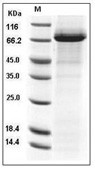
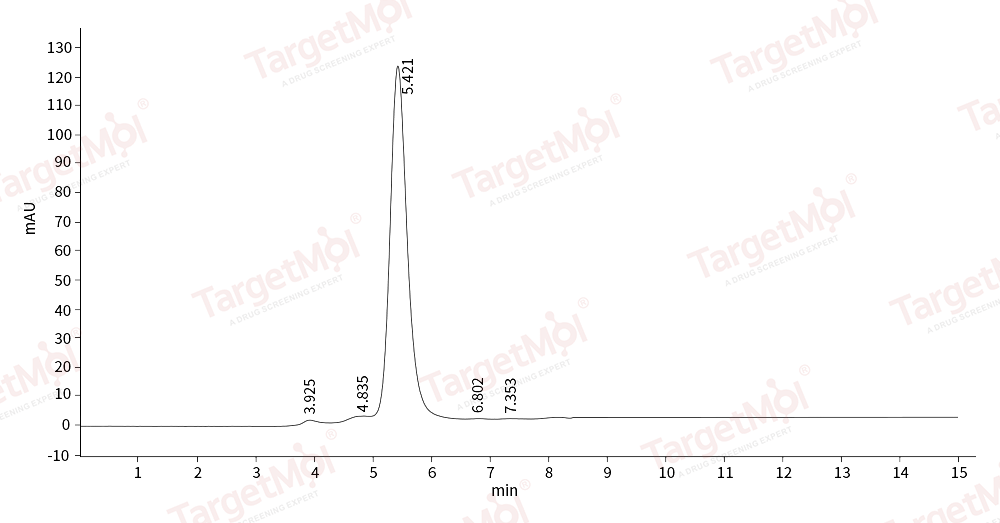
| 蛋白纯度 | ≥ 85 % as determined by SDS-PAGE. ≥ 90 % as determined by SEC-HPLC. ![]() ![]() |
| 蛋白性状 | Lyophilized powder |
| 缓冲液 | Lyophilized from a solution filtered through a 0.22 μm filter, containing PBS, pH 7.4. Typically, a mixture containing 5% to 8% trehalose, mannitol, and 0.01% Tween 80 is incorporated as a protective agent before lyophilization. |
| 复溶方法 | Reconstituted with sterile deionized water to 0.25 mg/mL. Reconstitution conditions may vary depending on the lot. |
| 别名 | FXI, coagulation factor XI, coagulation factor 11 |
| 内毒素 | < 1.0 EU/μg of the protein as determined by the LAL method. |
| 分子量 | 69.5 kDa (predicted); 75-80 kDa (reducing condition, due to glycosylation) |
| 运输方式 | In general, lyophilized powders are shipped with blue ice, while solutions are shipped with dry ice. |
| 存储 | It is recommended to store recombinant proteins at -20°C to -80°C for future use. Lyophilized powders can be stably stored for over 12 months, while liquid products can be stored for 6-12 months at -80°C. For reconstituted protein solutions, the solution can be stored at -20°C to -80°C for at least 3 months. Please avoid multiple freeze-thaw cycles and store products in aliquots. |
对于不同动物的给药剂量换算,您也可以参考 更多