



购物车
 您的购物车当前为空


 还可以
TrkA Protein, Human, Recombinant (G667C, GST) is expressed in Baculovirus-Insect Cells. The accession number is P04629.
还可以别名 TRKA, TRK, NTRK1, MTC, High affinity nerve growth factor receptor
TrkA Protein, Human, Recombinant (G667C, GST) is expressed in Baculovirus-Insect Cells. The accession number is P04629.
| 规格 | 价格 | 库存 | 数量 |
|---|---|---|---|
| 10 μg | ¥ 5,830 | 35日内发货 |
TargetMol的所有产品仅用作科学研究或药证申报,不能被用于人体,我们不向个人提供产品和服务。请您遵守承诺用途,不得违反法律法规规定用于任何其他用途。
| 产品描述 | TrkA Protein, Human, Recombinant (G667C, GST) is expressed in Baculovirus-Insect Cells. The accession number is P04629. |
| 生物活性 | The specific activity of TRKA (G667C) was determined to be 22-26 nmol/min/mg by radioactive kinase assay. 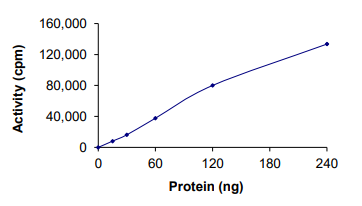 |
| 研究背景 | TRKA is a member of the neurotrophic tyrosine kinase receptor (NTKR) family. It is a membrane-bound receptor that, upon neurotrophin binding, phosphorylates itself and members of the MAPK pathway. Isoform TrkA-III promotes angiogenesis and has oncogenic activity when overexpressed. Isoform TrkA-I is found in most non-neuronal tissues. Isoform TrkA-II is primarily expressed in neuronal cells. TrkA-III is specifically expressed by the pluripotent neural stem and neural crest progenitors. The presence of NTRK1 leads to cell differentiation and may play a role in specifying sensory neuron subtypes. Mutations in the TRKA gene have been associated with congenital insensitivity to pain, anhidrosis, self-mutilating behavior, mental retardation, and cancer. It was originally identified as an oncogene as it is commonly mutated in cancers, particularly colon and thyroid carcinomas. TRKA is required for high-affinity binding to nerve growth factor (NGF), neurotrophin-3 and neurotrophin-4/5 but not brain-derived neurotrophic factor (BDNF). Known substrates for the Trk receptors are SHC1, PI 3-kinase, and PLC-gamma-1. NTRK1 has a crucial role in the development and function of the nociceptive reception system as well as the establishment of thermal regulation via sweating. It also activates ERK1 by either SHC1- or PLC-gamma-1-dependent signaling pathway. Defects in NTRK1 are a cause of congenital insensitivity to pain with anhidrosis and thyroid papillary carcinoma. |
| 种属 | Human |
| 表达系统 | Baculovirus-Insect Cells |
| 标签 | N-GST |
| 蛋白编号 | P04629 |
| 蛋白构建 | Recombinant human TRKA (G667C) (440-end) was expressed by baculovirus in Sf9 insect cells using an N-terminal GST tag. |
| 蛋白纯度 | >70% as determined by SDS-PAGE. 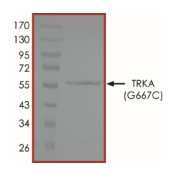 |
| 蛋白性状 | Solution |
| 缓冲液 | Supplied as sterile 50 mM Tris-HCl, pH 7.5, 50-300mM NaCl, 10mM glutathione, 0.1mM EDTA, 0.25-1.0mM DTT, 0-0.1mM PMSF, 10-25% glycerol |
| 别名 | TRKA, TRK, NTRK1, MTC, High affinity nerve growth factor receptor |
| 分子量 | ~66 kDa |
| 运输方式 | Enzymes are highly recommended to be shipped at frozen temperature with dry ice. Shipment made at ambient temperature may seriously affect the activity of the ordered products. |
| 存储 | It is recommended to store recombinant proteins at -20°C to -80°C for future use. Lyophilized powders can be stably stored for over 12 months, while liquid products can be stored for 6-12 months at -80°C. For reconstituted protein solutions, the solution can be stored at -20°C to -80°C for at least 3 months. Please avoid multiple freeze-thaw cycles and store products in aliquots. 实际储存温度请以COA为准 |
对于不同动物的给药剂量换算,您也可以参考 更多

 嗨!有任何问题?点我咨询


版权所有©2015-2026 TargetMol Chemicals Inc.保留所有权利.
沪ICP备20019793号-4 | 沪公网安备 31010602006700号 | 沪(静)应急管危经许[2024]203441