



购物车
 您的购物车当前为空

 很棒
CXADR/CAR Protein, Human, Recombinant (His) is expressed in HEK293 mammalian cells with His tag. The predicted molecular weight is 25.6 kDa and the accession number is P78310-1.
很棒纯度: 98.3%
别名 HCAR, CXADR, coxsackie virus and adenovirus receptor, CAR4/6, CAR
CXADR/CAR Protein, Human, Recombinant (His) is expressed in HEK293 mammalian cells with His tag. The predicted molecular weight is 25.6 kDa and the accession number is P78310-1.
| 规格 | 价格 | 库存 | 数量 |
|---|---|---|---|
| 5 μg | ¥ 392 | 现货 | |
| 10 μg | ¥ 647 | 现货 | |
| 20 μg | ¥ 1,060 | 现货 | |
| 50 μg | ¥ 1,980 | 现货 | |
| 100 μg | ¥ 3,530 | 现货 | |
| 200 μg | ¥ 6,230 | 5日内发货 | |
| 500 μg | ¥ 13,200 | 5日内发货 |
TargetMol的所有产品仅用作科学研究或药证申报,不能被用于人体,我们不向个人提供产品和服务。请您遵守承诺用途,不得违反法律法规规定用于任何其他用途。
| 产品描述 | CXADR/CAR Protein, Human, Recombinant (His) is expressed in HEK293 mammalian cells with His tag. The predicted molecular weight is 25.6 kDa and the accession number is P78310-1. |
| 生物活性 | Activity testing is in progress. It is theoretically active, but we cannot guarantee it. If you require protein activity, we recommend choosing the eukaryotic expression version first. |
| 研究背景 | CXADR (coxsackie virus and adenovirus receptor), also known as CAR, is a type I transmembrane glycoprotein belonging to the CTX family of the Ig superfamily, and is essential for normal cardiac development in the mouse. Proposed as a homophilic cell adhesion molecule, CXADR is a component of the epithelial apical junction complex that is essential for the tight junction integrity, and probably involved in transepithelial migration of polymorphonuclear leukocytes (PMN). Mature mouse CXADR structrually comprises a 218 aa extracellular domain (ECD) with a V-type (D1) and a C2-type (D2) Ig-like domain, a 21 aa transmembrane segment and a 17 aa intracellular domain, among which,D1 is thought to be responsible for homodimer formation in trans within tight junctions. The ECD of mouse CXADR shares 97%, 9% sequence identity with the corresponding regions of rat, human CXADR. |
| 种属 | Human |
| 表达系统 | HEK293 Cells |
| 标签 | C-His |
| 蛋白编号 | P78310-1 |
| 蛋白构建 | A DNA sequence encoding the human CXADR (NP_001329.1) extracellular domain (Met 1-Gly 237) was fused with a polyhistidine tag at the C-terminus. Predicted N terminal: Leu 20 |
| 蛋白纯度 | ≥ 92 % as determined by SDS-PAGE. ≥ 95 % as determined by SEC-HPLC. 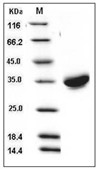 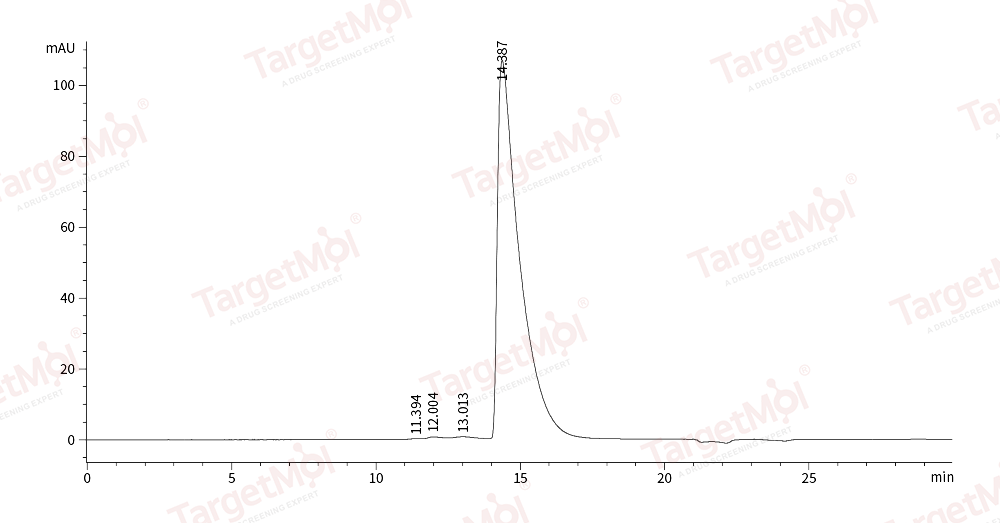 |
| 蛋白性状 | Lyophilized powder |
| 缓冲液 | Lyophilized from a solution filtered through a 0.22 μm filter, containing PBS, pH 7.4. Typically, a mixture containing 5% to 8% trehalose, mannitol, and 0.01% Tween 80 is incorporated as a protective agent before lyophilization. |
| 复溶方法 | Reconstituted with sterile deionized water to 0.25 mg/mL. Reconstitution conditions may vary depending on the lot. |
| 别名 | HCAR, CXADR, coxsackie virus and adenovirus receptor, CAR4/6, CAR |
| 内毒素 | < 1.0 EU/μg of the protein as determined by the LAL method. |
| 分子量 | 25.6 kDa (predicted); 35 kDa (reducing condition, due to glycosylation) |
| 运输方式 | In general, lyophilized powders are shipped with blue ice, while solutions are shipped with dry ice. |
| 存储 | It is recommended to store recombinant proteins at -20°C to -80°C for future use. Lyophilized powders can be stably stored for over 12 months, while liquid products can be stored for 6-12 months at -80°C. For reconstituted protein solutions, the solution can be stored at -20°C to -80°C for at least 3 months. Please avoid multiple freeze-thaw cycles and store products in aliquots. 实际储存温度请以COA为准 |
对于不同动物的给药剂量换算,您也可以参考 更多

 嗨!有任何问题?点我咨询


版权所有©2015-2026 TargetMol Chemicals Inc.保留所有权利.
沪ICP备20019793号-4 | 沪公网安备 31010602006700号 | 沪(静)应急管危经许[2024]203441